


A featured snippet and an AI Overview can appear around the same topic, but they are different search features. Winning one does not mean your page has been selected for the other.
Featured snippet work starts with a relevant question and a page that answers it well. You can improve the source page and monitor the result; you cannot assign the feature to yourself.
Verify the actual search result
Inspect the query in the country and device context that matters. Record whether a featured snippet appears, what format it uses, which page is selected, and whether other features change the layout.
Do not rely on a fixed drawing of “the 2026 SERP.” Search layouts vary by query and observation. Save a dated result for the opportunities you intend to pursue.
Google explains that its systems determine featured snippet selection. There is no publisher markup that directly designates a page as a featured snippet.
Match the answer format to the task
A definition usually benefits from a concise paragraph with a clear subject. A procedure benefits from an ordered sequence with prerequisites. A comparison benefits from a table whose columns use consistent criteria and units.
Do not force a table into a question that needs an explanation. Do not shorten a procedure so aggressively that the answer becomes unsafe or unusable. The surrounding section should provide the context a visitor needs after reading the summary.
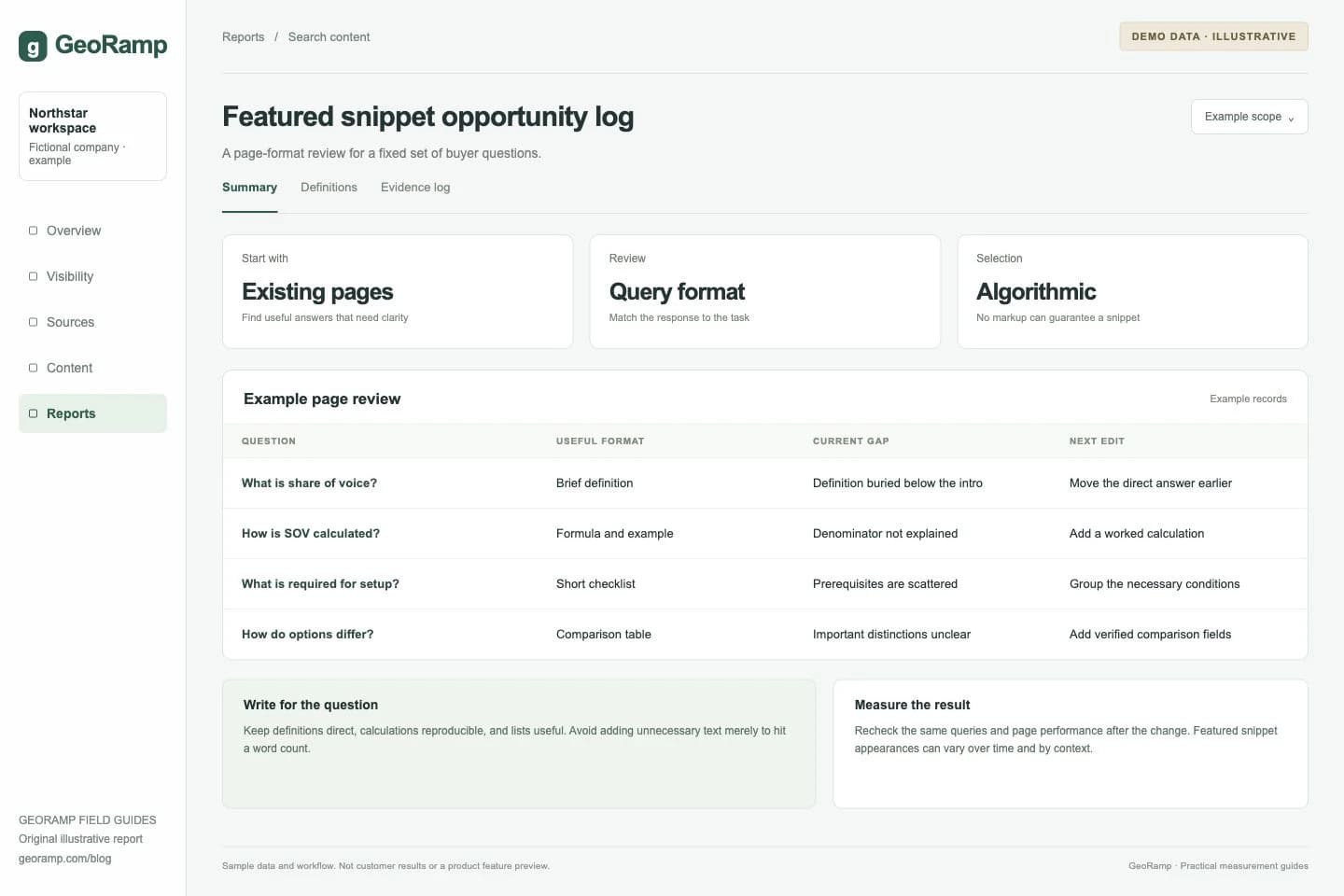
Illustrative report with fictional data and workflow examples. This is not a customer result or a preview of a specific product screen.
The illustrative opportunity log records query, answer format, target page, observation, and next task. It is a planning example, not a screenshot of a current Google result.
Improve the existing page first
Check whether a current page already serves the intent. Add a descriptive heading and a direct answer where appropriate. Remove contradictory wording and make important caveats part of the answer.
For a calculation, define the inputs and show a worked example. For a list, explain the selection rule. For a product question, state the relevant plan, version, or prerequisite. These details improve usefulness even when the page is never selected for a snippet.
Keep source attribution close to empirical claims. A short answer with a dramatic but unsupported number is not a good candidate for publication.
Preserve technical eligibility
Confirm the page is accessible and intended for indexing. Review any snippet controls before changing them, since they may affect how much content can be shown in Search. Do not alter those controls simply to pursue a visual feature without understanding their purpose.
When the content depends on client-side rendering, inspect whether the answer is available in the representation being evaluated. The page inspection guide provides the diagnostic steps.
Measure the feature and the outcome
Repeat the query observations under comparable conditions. Track snippet presence and the selected URL separately from ordinary position and AI Overview citations.
Use Search Console and analytics to review impressions, clicks, and the behavior of visitors who arrive. A visible feature is not automatically a traffic or conversion improvement. Changes in the query mix and result layout can complicate a simple before-and-after comparison.
Keep a short change log so a later reviewer knows what was edited and when. If the feature does not appear, inspect the answer and competition again before making another change.
For generated-answer work, continue with Google AI Overviews. For a report that keeps search features separate, use AI rank tracking.


