


A model can produce twenty title options in seconds and still invent the central statistic in the article. The useful SEO workflow gives it a bounded task, supplies evidence, and defines what a reviewer must verify.
ChatGPT can assist with research organization and editorial work. The quality of the result depends on the information you provide, the tools available in the session, and the checks performed before publication.
Start with supplied evidence
Collect product documentation, approved claims, actual customer questions, and the pages being evaluated. Tell the model which material is authoritative and which claims require verification.
Keep private customer information out of a workflow unless its use is appropriate for your organization and the tool configuration. A public article rarely needs personal details to explain a useful example.
Use a prompt such as:
Group these supplied buyer questions by decision. Preserve each original question and its source ID. Do not invent search volumes or add unsupported questions. Flag overlaps that one page could answer.
Review the clusters with someone who knows the product. A linguistically tidy group can combine questions that actually require different answers.
Build a brief before a draft
Ask for the target reader, decision, existing page, missing evidence, proposed structure, and next action. Require the brief to distinguish known facts from questions the writer still needs to investigate.
Create a brief for this integration guide using only the supplied documentation. Include prerequisites, supported versions, limitations, and a verification checklist. Mark missing facts as “needs source.”
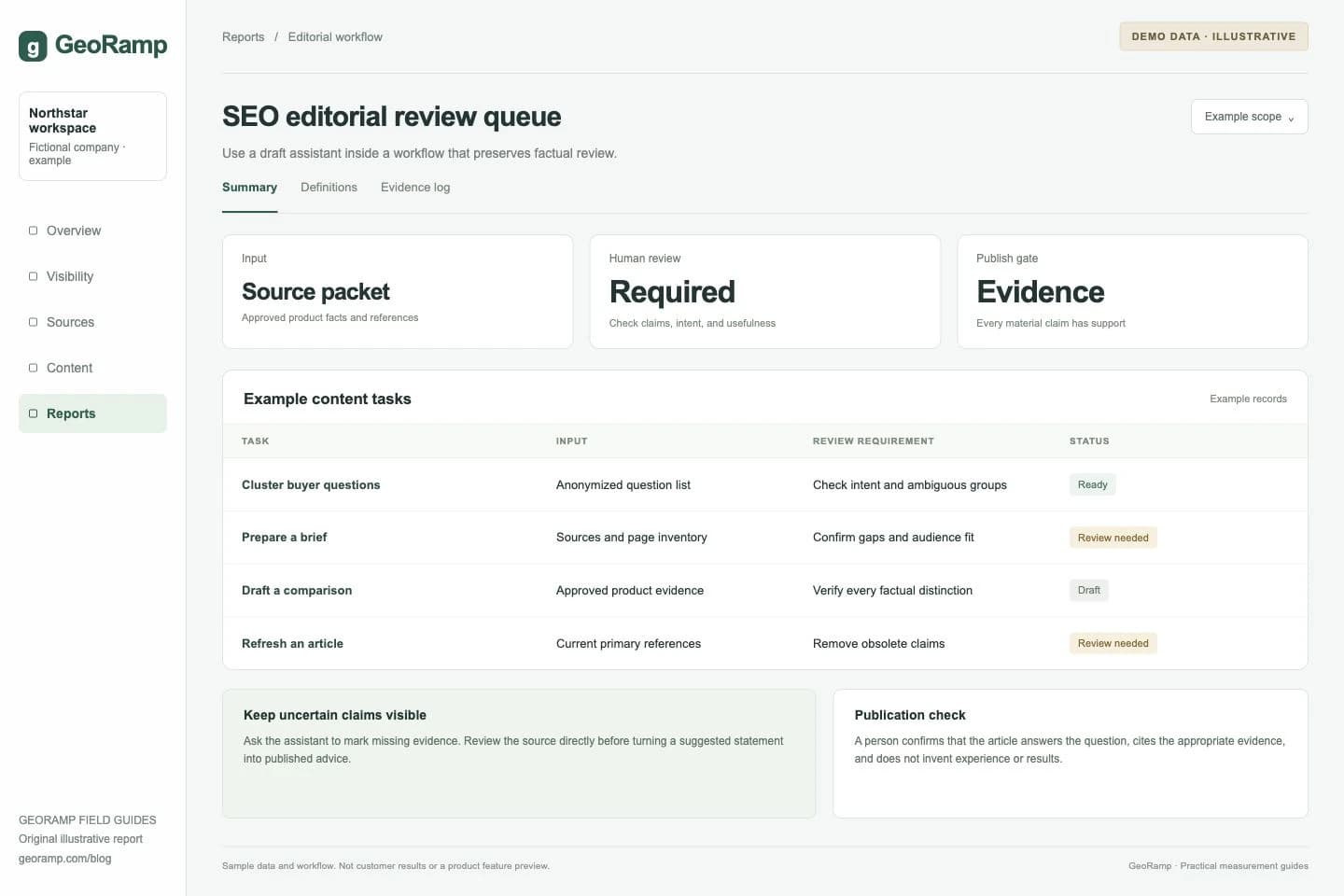
Illustrative report with fictional data and workflow examples. This is not a customer result or a preview of a specific product screen.
The example editorial queue shows separate stages for source collection, briefing, drafting, review, and publication. Completion of a drafting task does not establish that its claims are verified.
Draft a bounded section
Give the model a specific section rather than an instruction to produce an authoritative article from nothing. For example, request a comparison of two deployment options using a supplied feature matrix.
Require clear subjects, units, and caveats. Ask it to retain meaningful limitations and remove generic promotional language. Then compare the draft with the source material yourself.
Do not accept a citation because the URL looks plausible. Open the source and confirm that it supports the exact claim, uses the relevant date, and has not been confused with a forecast or vendor testimonial.
Use the model as a structured reviewer
A useful review prompt asks for specific failure types:
Review this draft for unsupported numbers, ambiguous product claims, repeated sections, broken logical steps, and questions left unanswered. Quote the passage being flagged and explain what evidence would resolve it. Do not rewrite accurate passages just to make them sound smoother.
A second review can check consistency between the introduction, body, tables, and conclusion. If a percentage appears in several places, verify that the numerator and denominator remain the same.
Treat generated code as a draft too
For structured data, provide the exact visible facts and the intended schema type. Validate the output with appropriate tools and confirm it matches the page. Never add invented ratings, review counts, or product attributes.
For redirects, metadata, or technical fixes, inspect the actual application before applying a suggested snippet. A correct-looking example can still be wrong for the framework or route structure in use.
Keep publishing and measurement explicit
Use a release checklist that covers facts, links, images, metadata, rendering, and indexability. A connected agent may be able to perform parts of the process, but the evidence of completion still matters.
Measure the published page with the relevant search and analytics tools. A model's opinion that a page is “AI optimized” is not a visibility result. If your goal is appearing in ChatGPT answers, use the separate ChatGPT visibility guide and a documented citation analysis process.


