

Your brand can appear in an AI answer without your website being cited. Your website can also be cited for a factual explanation without the answer recommending your product. A visibility program needs to preserve that distinction.
AI search visibility describes your presence in a defined set of generated answers. To make it useful, specify the questions, platforms, modes, time period, and kind of presence you are counting.
Choose the question set before the metric
Collect questions from sales conversations, support tickets, site search, and product evaluation calls. Group them by the decision the buyer is making. “What is this category?” and “Which tool supports our deployment requirement?” should not be treated as equally close to a purchase.
Keep a fixed core sample for trends. Store exploratory questions separately. If you add a large group of branded prompts halfway through the month, a higher appearance rate may simply reflect an easier sample.
Use consistent language and geography. Record whether the assistant searched the web, and distinguish its consumer interface from API-based collection. These conditions are part of the dataset, not optional notes.
Keep mention and citation rates separate
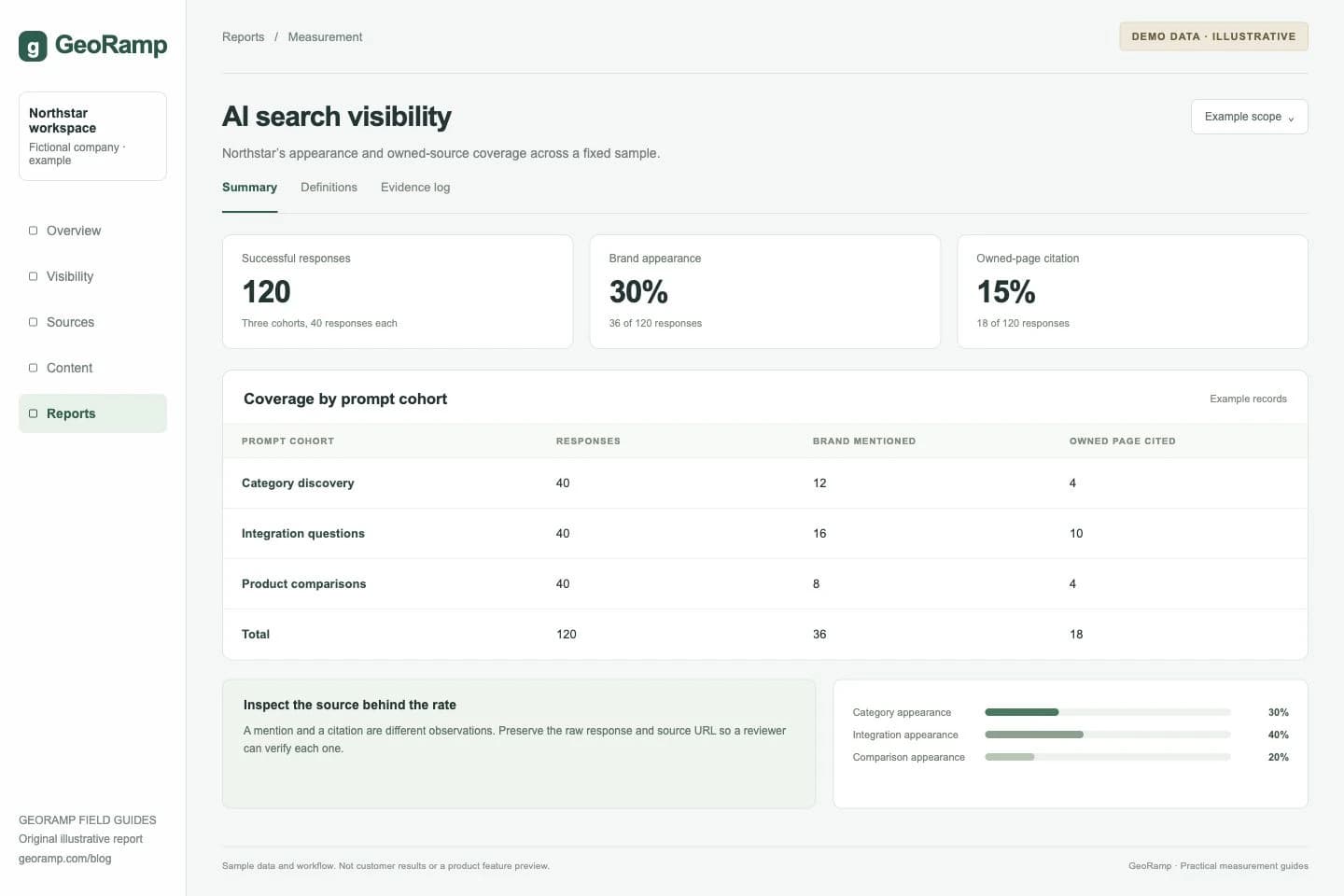
Imagine 120 successful responses to a fixed set of prompts. The example brand appears in 36 responses, while 18 responses link to at least one page on its domain.
| Metric | Numerator | Denominator | Rate |
|---|---|---|---|
| Brand appearance | Responses naming the brand | Successful responses | 30% |
| Owned-page citation | Responses linking to the brand's site | Successful responses | 15% |
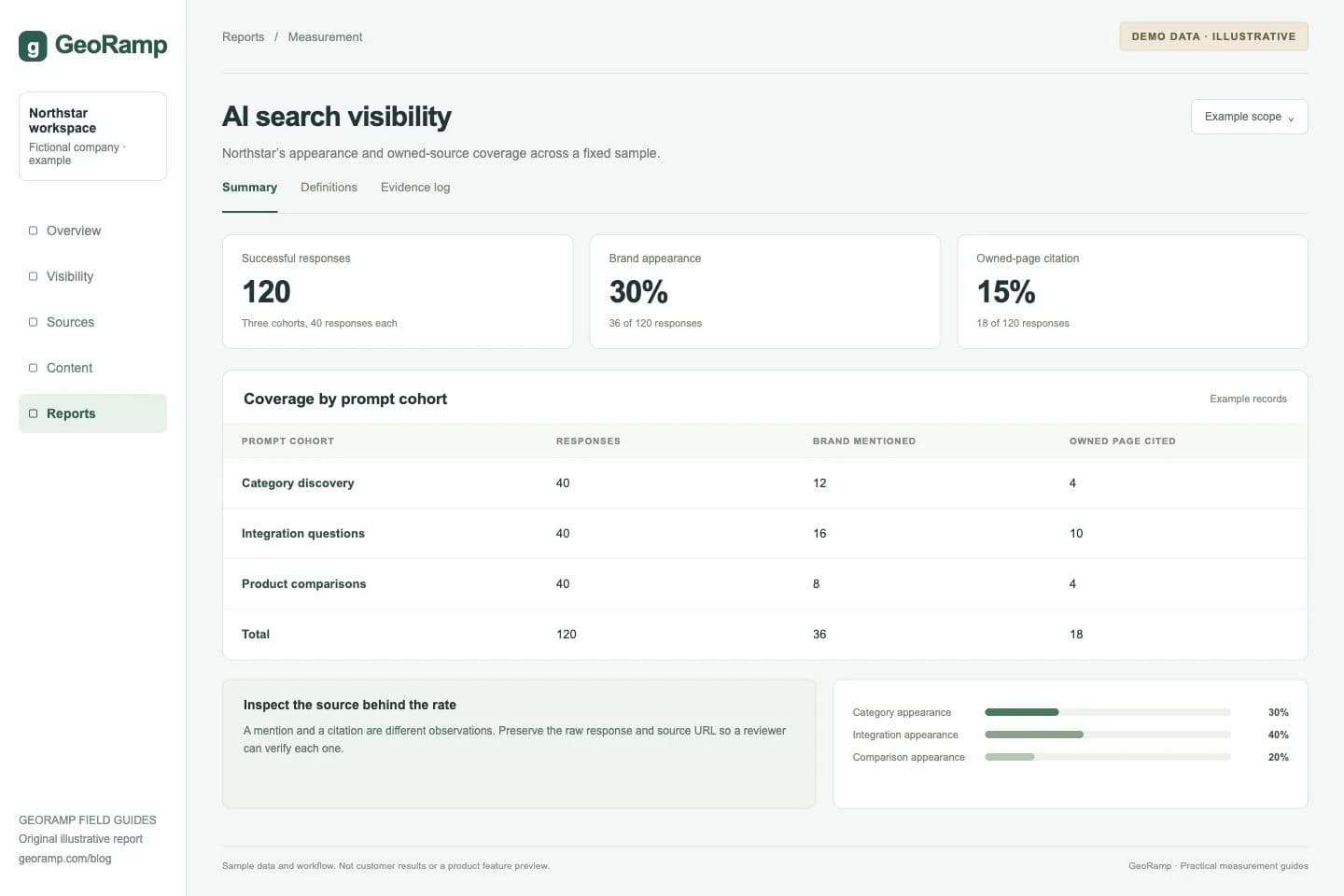
Illustrative report with fictional data and workflow examples. This is not a customer result or a preview of a specific product screen.
Both rates can overlap with competitors' rates because one answer can include several brands. A competitive citation-event share uses a different denominator: total counted citation events across the selected brands. See the share-of-voice calculation guide before putting these measures on the same chart.
Inspect the answers behind the percentage
Read a sample of responses where the brand appears and a sample where it is absent. Check whether the description is accurate, whether the answer addresses the buyer's constraint, and which pages support its claims.
Classify the gap before assigning work. An incorrect plan limit calls for a source-of-truth review. Missing integration coverage calls for useful documentation. A recommendation based on third-party reviews may require work beyond your own website.
Sentiment labels can help triage responses, but retain the text. A sentence that calls the product unsuitable for a large enterprise may be accurate positioning, not a reputation problem to erase.
Improve the source material
Make important product facts easy to find and maintain. Explain limits, prerequisites, and tradeoffs. Link related documentation and comparison material where it helps a visitor continue the evaluation.
Add original evidence when you have it, with dates and methods. Do not invent usage figures or customer results to make a page sound authoritative. A clear statement of what a product does and does not support is more useful than an unsupported performance claim.
Check public-page access as a separate task. A content improvement cannot help a retrieval system that receives an error or an empty response. The page inspection guide covers that diagnostic process.
Evaluate changes as experiments
Record the pages changed, the reason for each change, and its release date. Repeat the same prompt sample and compare the raw responses as well as the rates. Keep an unchanged group of topics when practical, so a platform-wide movement is easier to spot.
An increase after an edit is an observation, not automatic proof of causation. Use referral quality, qualified inquiries, and sales feedback to decide whether the visibility is commercially useful. The AI SEO strategy guide turns that measurement loop into an operating plan.


