


A team buys an AI visibility tool, watches a score move, and still cannot say which page to improve next. The missing piece is an operating plan that connects an observed gap to an owner, an edit, and a later review.
An AI SEO strategy should specify what the business wants to learn and change. Tool selection comes after the measurement question and the capacity to act on the results.
Write a narrow objective
Choose a product category, audience, and buying task. For example, an integration platform might investigate whether buyers comparing deployment options encounter accurate information about its supported environments.
Define what a useful result looks like: clearer source coverage, fewer inaccurate descriptions, identifiable qualified visits, or enough evidence to decide whether a topic deserves further investment. Avoid promising a fixed citation increase before you have a baseline.
Write down what the initial project excludes. A focused pilot is easier to interpret than simultaneous work across every product, language, and assistant. Expand the scope when the first cycle produces a useful decision.
Establish measurement and ownership together
Create a fixed prompt sample from real buyer questions. Record brand appearances, owned-page citations, source URLs, and collection conditions. Keep failed responses and sample changes visible.
Assign a measurement owner who can explain the dataset, a content owner who can correct the source material, and an engineering contact who can resolve access or rendering problems. One person can hold several roles, but each task needs an accountable owner.
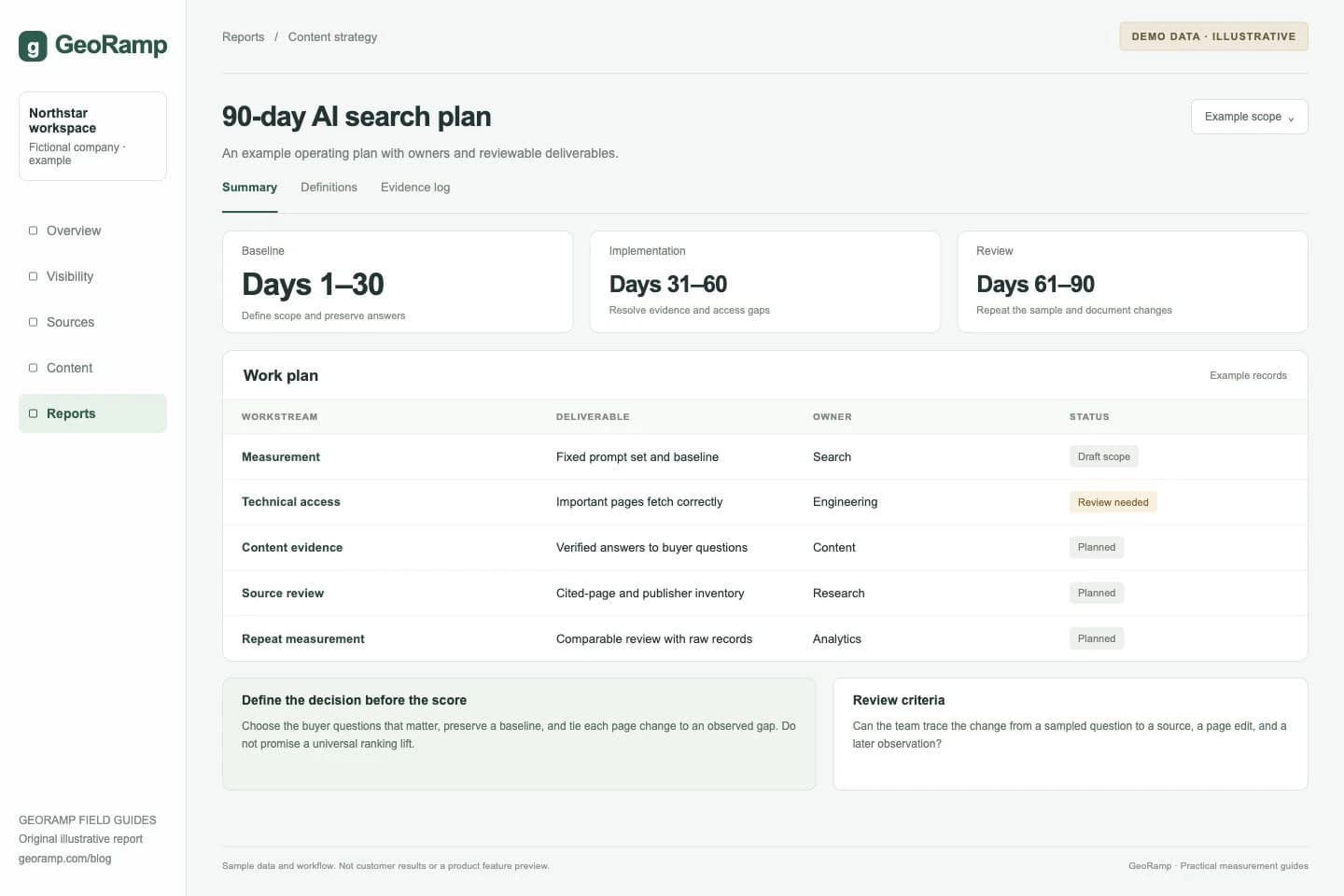
Illustrative report with fictional data and workflow examples. This is not a customer result or a preview of a specific product screen.
The example plan shows proposed work and review dates. Its progress indicators describe task completion, not forecast visibility gains.
Repair technical blockers first
Check whether priority public pages return successful responses, have the intended canonical URL, and contain their essential information in a usable representation. Investigate unexpected noindex directives, broken links, and bot-specific errors.
Keep these repairs separate from content experiments in the change log. Restoring access to a page and changing its explanation are different interventions, even when shipped together.
For Google, use the current generative AI optimization guidance as a reference for eligibility and established search foundations. Treat vendor-specific advice as a hypothesis when it goes beyond documented requirements.
Prioritize useful source changes
Read the answers and cited pages for the highest-value gaps. Determine whether you need to improve an existing page, produce a genuinely missing resource, or correct an external listing.
An integration question may need a tested setup guide. A comparison question may need a candid explanation of limits and tradeoffs. A pricing question may need an unambiguous billing unit. These are different editorial jobs and should have different briefs.
Do not commission several near-duplicate pages simply because prompts use different wording. Give one strong page clear ownership of the underlying intent and link related resources where they add something distinct.
Use a proposed 90-day cycle
Spend the opening weeks establishing the sample and repairing access problems. Use the middle of the cycle to publish a small set of well-supported changes. Reserve the closing weeks for repeated observations, source review, and the next planning decision.
The exact dates depend on crawl timing, team capacity, and the amount of work. Ninety days is an operating window, not a promise that a ranking system will respond within it.
At review, distinguish completed work from observed outcomes. Report changes to the sample, changes to the website, visibility observations, and business signals in separate fields. An outcome that did not improve is still useful if the test was interpretable.
Decide what earns another cycle
Continue topics where the sample reflects real demand and the team can improve the available evidence. Revise topics where the prompts are unrealistic or the data cannot support a decision. Retire measurements that consume time without changing what anyone does.
Use the content gap template to turn the next priorities into briefs, and the share-of-voice report to keep the executive review compact.


