
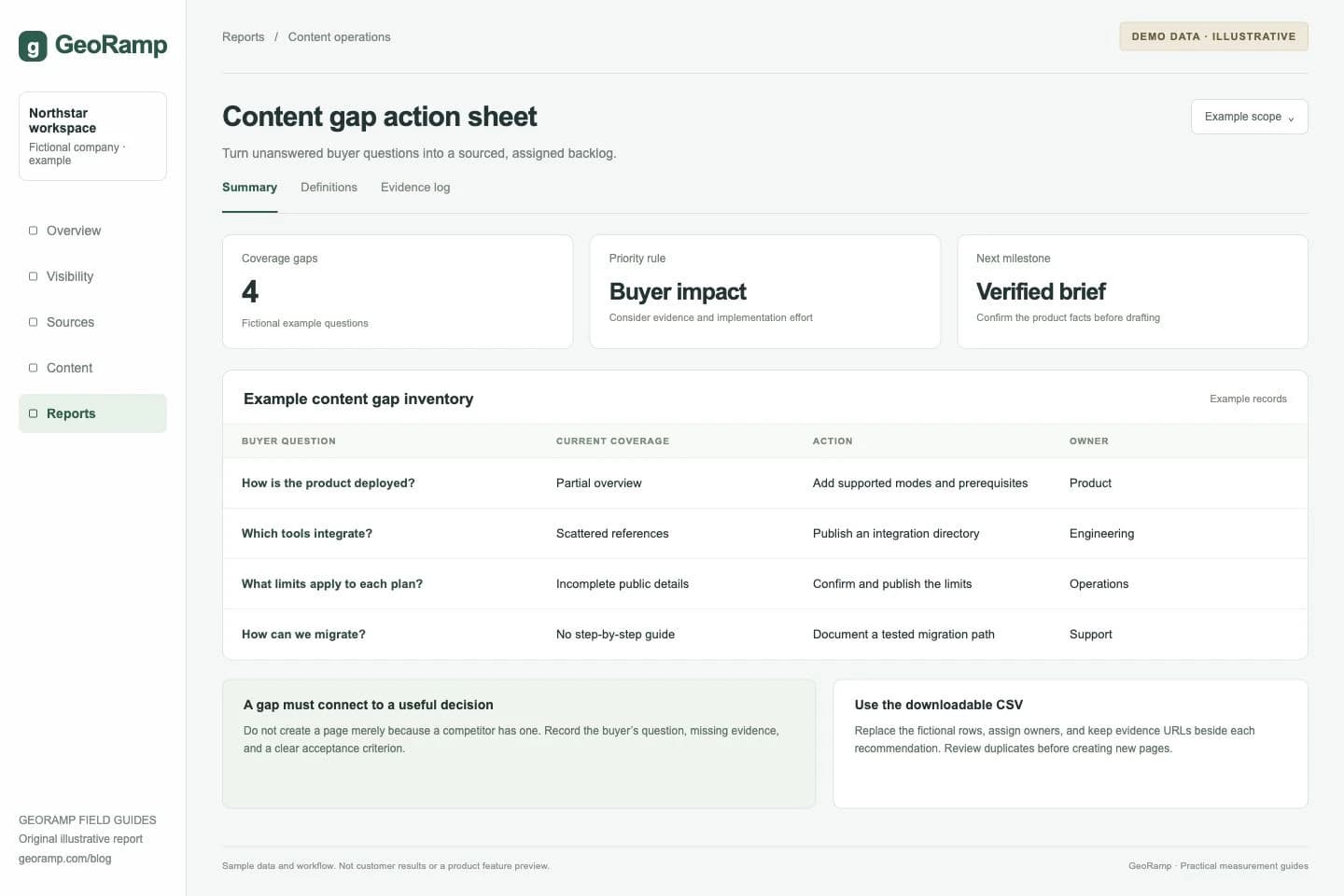

A competitor has an article you do not. That is a difference in content inventory, not yet a reason to write another article. The gap matters when it leaves a relevant buyer question unanswered.
This template starts with the question and evidence, then decides whether to improve a page, create a distinct resource, consolidate overlapping content, or take no action.
Download the content gap analysis CSV. Import it into Excel or Google Sheets. The included rows are illustrative and should be replaced with your own observations.
Use one row per underlying question
Record the audience, buyer question, intent, current page, competitor or cited source, evidence URL, observation date, gap, proposed action, owner, priority, and status.
Keep closely related phrasings together. If “private deployment options” and “can we self-host?” require the same answer, they may belong in the same brief. Split the rows when the questions require genuinely different evidence or serve different audiences.
For AI observations, add the prompt ID, platform, mode, and source page. For search observations, add the query set and geography. Optional search-volume estimates should retain their source and date.
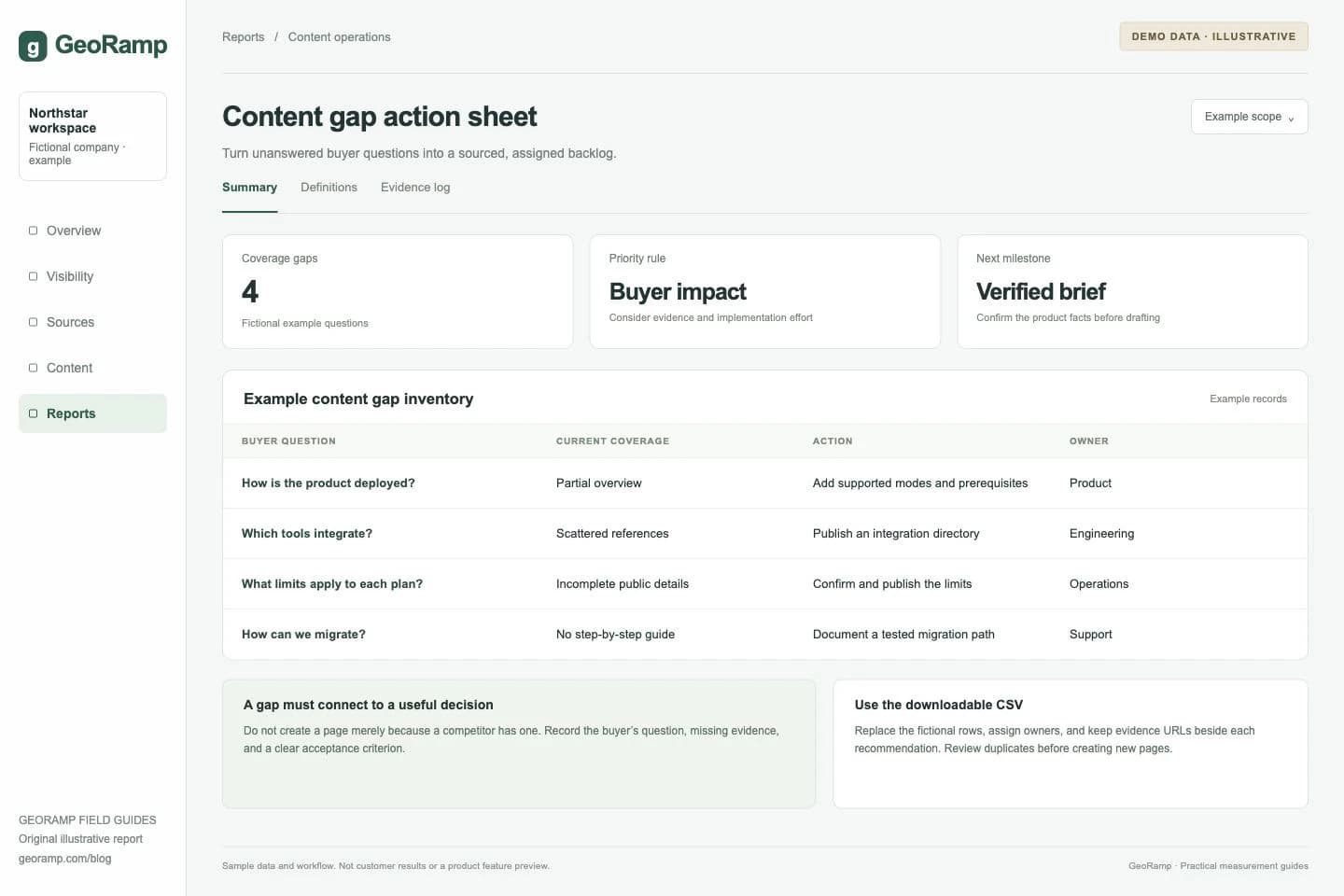
Illustrative report with fictional data and workflow examples. This is not a customer result or a preview of a specific product screen.
Classify the gap before choosing the action
Missing answer: the site does not explain the subject. Consider a new section or page based on the depth required.
Incomplete answer: a page exists but omits a prerequisite, limit, or example. Improve the existing page and keep its intent clear.
Weak evidence: the claim is present but unsupported. Collect documentation, a tested example, or an appropriately attributed source before adding more prose.
Access or discovery problem: the answer exists but is broken, difficult to find, or unavailable in the inspected representation. Assign a technical or navigation fix.
Overlapping coverage: several pages compete to explain the same task. Clarify their distinct roles or consolidate carefully, considering existing links and performance.
Prioritize with a written rationale
Use buyer relevance, evidence strength, implementation effort, and commercial importance. Keep the assessment short enough that another person can challenge it.
A high-volume topic can be low priority if it attracts the wrong audience. A narrow integration question can be high priority if it repeatedly blocks qualified evaluations. A competitor's ranking alone does not establish either judgment.
If you use a numeric score, document the scale and weights. Treat it as a planning aid. It is not a predicted probability of ranking or a forecast of revenue.
Turn a row into a brief
The brief should state the question, intended reader, page to edit, evidence to add, important limitations, proposed structure, and next useful action. Include links to sources so the writer does not have to reconstruct the research.
Define completion in concrete terms: the guide names the supported authentication methods, links to setup instructions, and explains the unsupported case. “Make the page more authoritative” is too vague to review.
Close the loop after publication
Add the release date and the measurement cohort that will be reviewed. Repeat the relevant search or prompt observations, inspect the result, and record what changed.
Keep “published” and “outcome observed” as separate statuses. A page can be complete even when there is not yet enough evidence to judge its visibility. This prevents the backlog from becoming a list of assumed wins.
For the broader research process, see competitive analysis. For an operating cadence, use the AI SEO strategy guide.


