


A buyer asks whether a tool supports a private deployment. Your product page says “enterprise-ready,” but never answers the question. That is an answer gap worth fixing before debating the wording of an AEO strategy.
Answer engine optimization is the work of making accurate, useful information available for systems that present direct answers. The term can include generated answers and conventional answer features. Specify the surface before choosing a metric.
Build a question-to-page map
Start with questions that affect a decision: compatibility, plan limits, migration steps, data handling, implementation effort, and alternatives. Record where each question came from so the list reflects actual demand.
Map each question to an existing page where possible. Several phrasings of the same underlying question usually belong in one useful explanation. Create a new page when the task needs distinct evidence or a different level of detail.
An answer brief should identify the reader, the precise question, the shortest accurate answer, supporting evidence, exceptions, and the next useful action. That is enough structure to make an editorial review concrete without forcing every article into the same template.
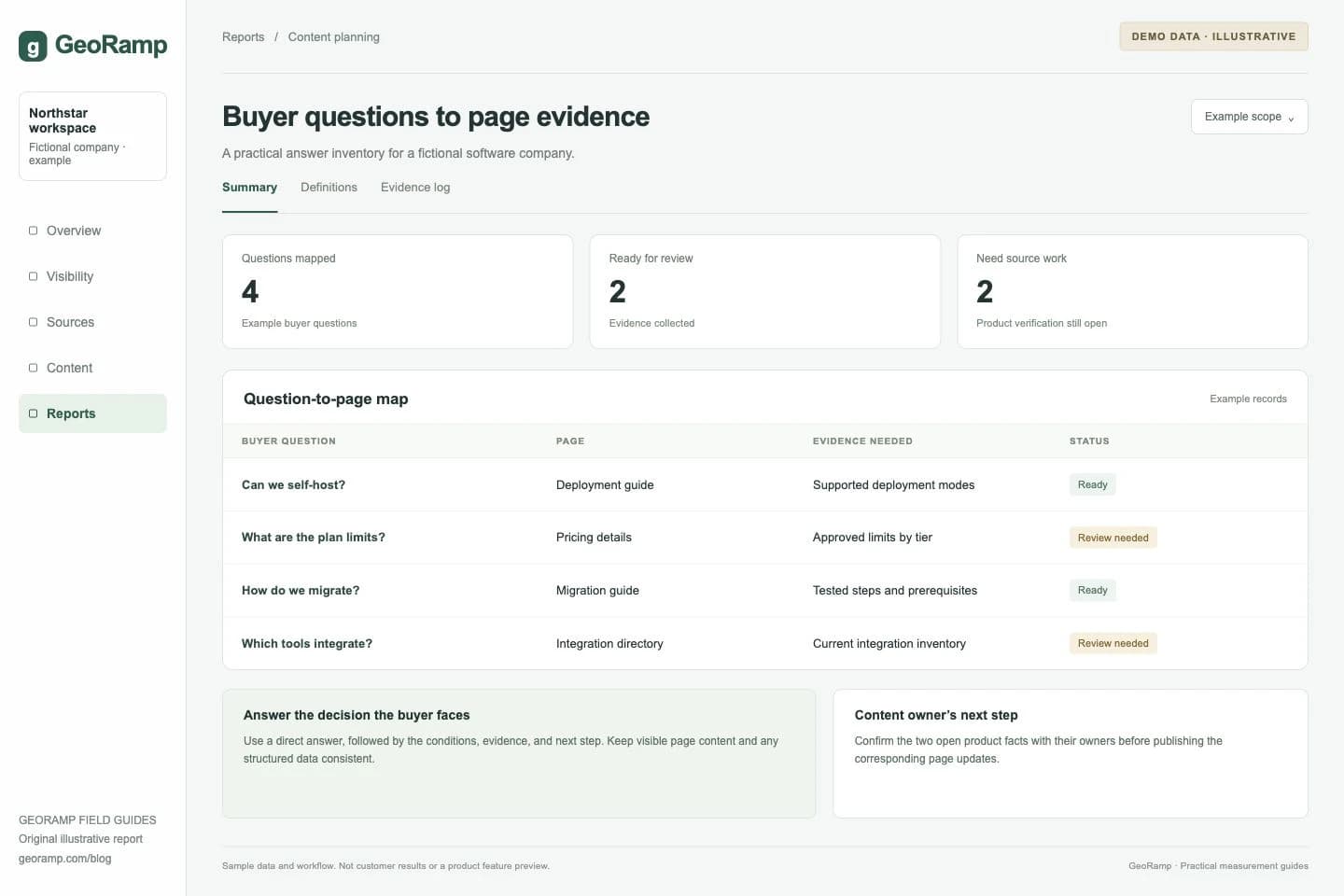
Illustrative report with fictional data and workflow examples. This is not a customer result or a preview of a specific product screen.
Write an answer that survives quotation
Put the central answer close to its heading. Name the subject clearly, include the relevant units, and keep important qualifications attached to the claim. “Available on the business plan” is more useful than “available on select plans” when the exact plan is known.
Then explain the conditions. If a feature requires an add-on, a particular integration version, or a manual setup step, the page should say so. A short answer that drops a decisive caveat is not an improvement.
For procedures, use ordered steps. For alternatives, use a comparison table whose rows describe the same criteria. For definitions, use prose. Choose the format that helps a human complete the task.
Supply evidence and maintain it
Link the source of claims that a reader should be able to verify. Product documentation may be the source for a supported feature; an original study may be the source for a statistic. Keep publication dates and observation dates distinct.
Use original screenshots when they demonstrate a process. Use labeled dummy data when you need to explain a report without publishing customer information. A polished example should never imply a measured customer outcome.
Assign an owner to facts that change. A precise pricing answer becomes misleading if nobody updates it when the billing model changes.
Check whether the answer is accessible
Confirm the public page works, the important answer is present in an inspectable representation, and related pages link to it. Test the visible page and the underlying text when a component depends on client-side interaction.
Structured data should describe the visible content accurately. Do not assume adding FAQ markup creates an entitlement to a rich result or an AI citation. Google's featured snippet guidance also makes clear that publishers cannot directly mark a page as a featured snippet.
Measure the result on the intended surface
For a generated-answer pilot, hold the question set and collection conditions stable. Record brand appearance and owned-page citation separately. Preserve the answer and sources so a reviewer can inspect what the percentage represents.
For a conventional answer feature, record whether the feature appeared and which URL was selected. Keep a successful result without the feature separate from a failed collection.
Review the page's business usefulness too. A technically extractable answer can still leave visitors unable to evaluate the product. The AI citations guide explains the measurement distinctions; the content optimization guide covers the editorial work.


