


A product page says "built for enterprise teams," but never answers whether SAML is included or which plan supports it. That is a content problem you can fix. Adding an AI SEO label or a block of schema does not supply the missing answer.
Content optimization for AI search starts with the questions buyers ask and the evidence your pages provide. This guide turns that into an editing and measurement process. For program-level context, read our AI search engine optimization guide.
Key Takeaways
-
Answer a specific buyer question and explain the conditions that change the answer.
-
Make facts verifiable through original sources, current product information, and transparent methods.
-
Keep pages accessible and structured data accurate. Google's AI features do not require special AI schema.
-
Establish a baseline, make a limited set of changes, and compare repeated samples. Citation changes alone do not prove commercial impact.
Choose a Page With a Clear Job
Start with a page relevant to an actual decision: evaluating an integration, comparing options, understanding a limitation, or estimating implementation effort. Use sales and support questions to identify missing explanations.
Inspect both the page and the answers you want it to inform. Record which sources are linked and what information those sources contain. A competitor's implementation guide may answer the question better than your broad feature page. That gives you a concrete editing task; a generic visibility score does not.
Choose a manageable first batch. An integration page and a comparison page with clear gaps are easier to review than a site-wide rewrite. Preserve the original content so you can identify what changed.
Lead With an Answer, Then Explain It
Put the direct answer near the heading that asks the question. Follow it with requirements, exceptions, and evidence. Readers should not have to search through positioning copy to find a plan limit or setup requirement.
For a fictional product, an answer could be: "SAML single sign-on is included on the Enterprise plan. An administrator must configure the identity provider before users can sign in through SSO." The next paragraph would cover supported providers and link to setup documentation.
Use lists and tables when they make conditions easier to compare. A comparison table needs consistent criteria and accurate information about each option. Do not declare your product the winner under every criterion or invent a competitor's limitations.
Headings should describe the information below them. Turn a heading into a question when that is natural, rather than forcing every section into the same template.
Add Evidence That a Reader Can Check
Replace "saves hours every week" with a measured result only if you have the data. Explain who was measured, over what period, and how the result was calculated. If no reliable measurement exists, describe the workflow and its limits without inventing an improvement percentage.
For external claims, link to the original research, documentation, or dataset near the claim. Check whether the source supports the population, date, and conclusion you are using. A study of one experimental system does not establish a universal effect across all assistants.
Product facts need the same discipline. State which plan includes a capability, which versions an integration supports, and when pricing was last checked. Add an author or reviewer with relevant, verifiable experience. A fabricated biography weakens the page's evidence.
Preserve Technical SEO Foundations
Google's guidance for AI features says ordinary SEO practices remain relevant. No additional technical requirements or special AI schema are needed for inclusion in AI Overviews or AI Mode.
Check that important pages can be crawled, indexed, and understood. Keep essential information in accessible text and provide crawlable internal links. Review accidental access restrictions before spending time on editorial changes.
Use applicable structured data that accurately represents visible content. Validate it after deployment. A useful question-and-answer section can help readers without being presented as a special schema tactic or a guaranteed citation trigger.
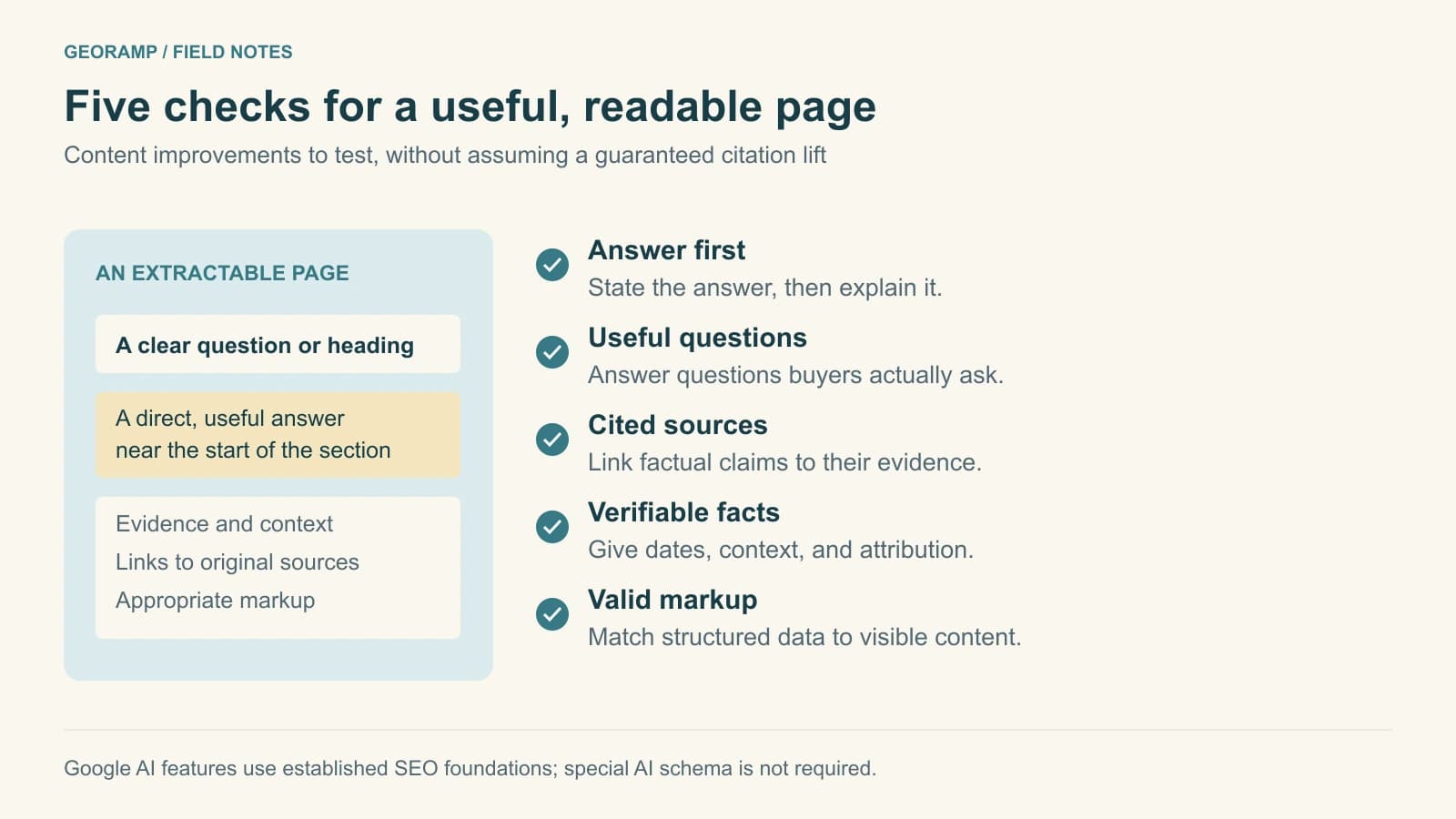
Editorial checks for a useful page. This graphic does not rank tactics by measured citation uplift.
Establish a Baseline Before Editing
Define the questions, assistants, modes, and collection settings you will compare. Separate branded prompts from category questions. Save the complete answers and source URLs where available, plus the collection date and any failures.
Measure brand appearance and own-domain citations separately. A response can mention your product and link only to third-party pages. Our AI citations guide explains how to read those signals; the calculation guide explains their denominators.
Collect more than one run when possible. Answer variability can produce a change even when your site is untouched. If the prompt set, assistant version, or mode changes, record that break rather than comparing the percentages as though the samples were identical.
Track business outcomes alongside visibility: relevant referral visits, engaged sessions, qualified inquiries, and conversions where attribution is available. A new citation may matter to a buyer without producing an immediate click, but citation counts alone cannot establish revenue.
A Practical 90-Day Editing Plan
The following sequence is a planning example. Adapt the batch size and timing to your team; it does not predict citation gains.
Establish the baseline
During the first two weeks, choose your question set and candidate pages. Inspect accessibility, current answers, linked sources, and analytics. Write down the missing information on each page and the decision it should support.
Fix access and structure
Use the next batch of work to resolve technical blockers and improve navigation. Bring direct answers closer to relevant headings. Add accurate markup where appropriate and check that it reflects visible content.
Strengthen the evidence
Review important claims against original sources. Add current product details, limitations, examples, and documented methods. Remove unsupported statistics and claims of firsthand experience. The goal is a more useful explanation, not a quota of numbers or outbound links.
Fill a specific buyer-question gap
Create a new page when the existing material cannot reasonably answer a distinct question. That might be an implementation guide or a comparison with consistent criteria. Link it from relevant existing pages so readers and crawlers can discover it.
Collect a comparable sample and review
At the end of the sprint, repeat the original collection settings and compare the saved answers and source URLs. Note any platform changes. Evaluate visibility alongside visits and inquiries, then choose the next editing batch.
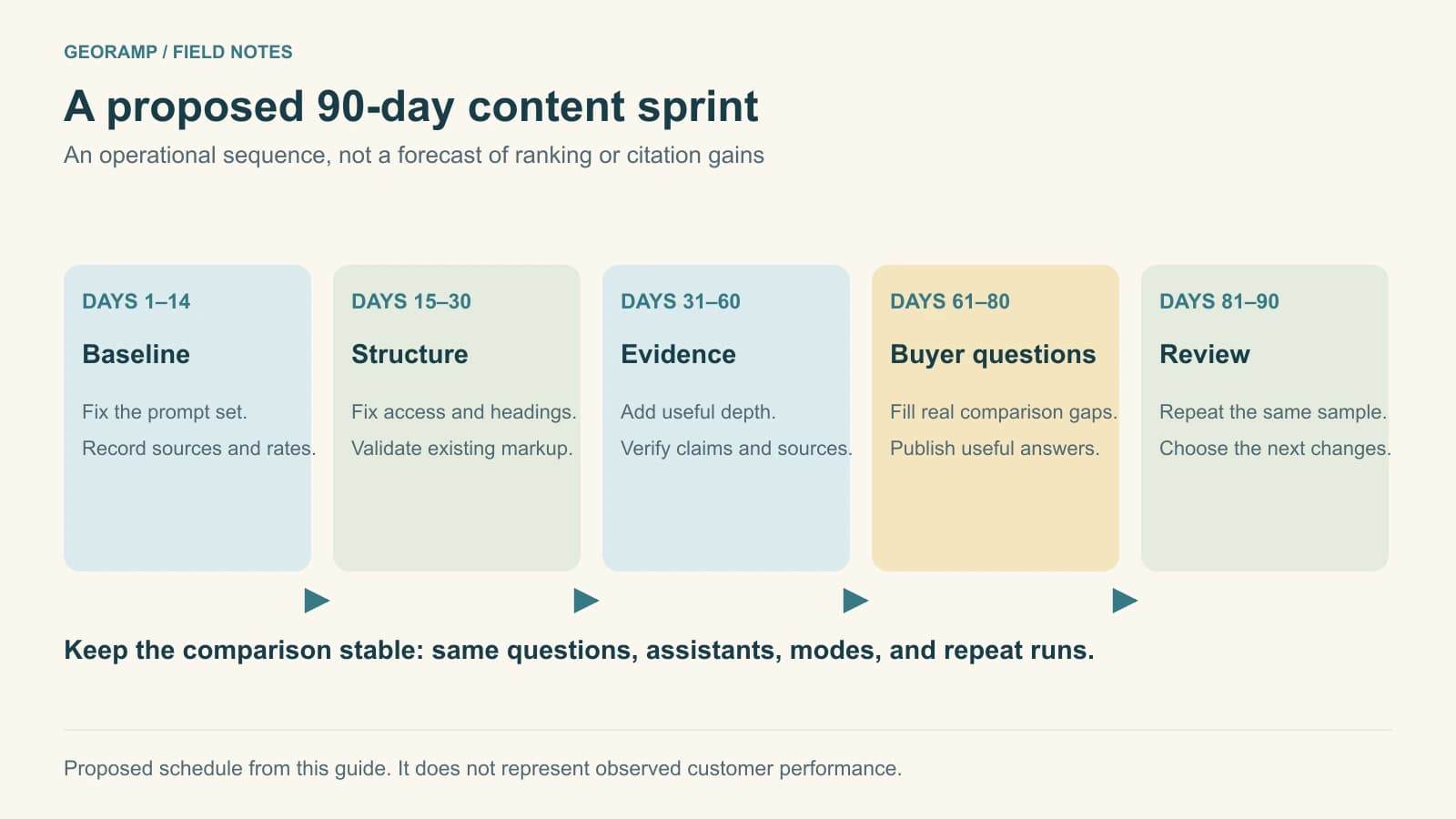
Proposed planning sequence. The timeline does not show observed customer results or predict citation gains.
Report What Changed Without Inventing Causality
Suppose a fictional team edits an integration page and later sees more sampled answers linking to it. The report should record the content changes, collection dates, sample sizes, and citation counts. It should also note whether the assistant or prompt mix changed.
That observation justifies further investigation. It does not establish that schema caused the increase or that repeating the work will deliver the same result elsewhere. If several changes shipped together, avoid assigning a precise uplift to each one.
Keep the next decision concrete: correct an outdated fact, answer a missing implementation question, investigate a recurring retrieval error, or test whether a newly cited page attracts relevant visitors. This makes the work easier to review than a promise to "optimize for every AI engine."
Start with a visibility baseline
Check how your brand appears in AI answers before choosing your next content edits.
Check my visibility →

