


Ask an assistant "what is the best [category] software" and check two things: which brands the answer names, and which pages it links as sources. A named brand is a mention. A linked supporting page is a citation. An answer can recommend your product while citing a review site, so those signals need separate measurement.
This guide explains how to read citations, investigate the source pages behind them, and choose content changes worth testing. For the wider program, start with our AI search engine optimization guide.
Key Takeaways
-
Track brand mentions, linked sources, and citations to your own domain separately.
-
Record the exact source URL, prompt, assistant, mode, and collection date. A percentage without its sample definition is hard to interpret.
-
Make useful evidence easy to find: clear answers, accurate facts, accessible pages, and links to original sources.
-
Citation counts measure visibility. Check referral traffic and business outcomes before treating them as acquisition results.
What Counts as an AI Citation?
A linked citation points from an answer to a supporting web page. It may appear as a numbered reference, an inline link, or an entry in a sources panel. Inspect the destination: a link to your homepage and a link to an independent comparison article tell you different things.
A mention answers "was the brand named?" A citation answers "which page was linked as a source?" Neither tells you whether the answer accurately described the product. Save enough of the answer to check context, including any incorrect pricing, features, or comparisons.
For example, an assistant might recommend Wisteria Analytics and cite an industry review containing its name. That is a brand mention and a third-party citation. It is not a citation to Wisteria's website.
How a Web-Grounded Answer Can Select Sources
A simplified flow is: interpret the question, retrieve candidate pages, select supporting material, and generate an answer that may include source links. The implementation varies by assistant and mode. A response generated without web retrieval is a different observation from a search-enabled answer.
Information stored in a model's parameters is also different from a page retrieved during the current conversation. You cannot reconstruct a proprietary ranking formula by looking at one answer's source list.
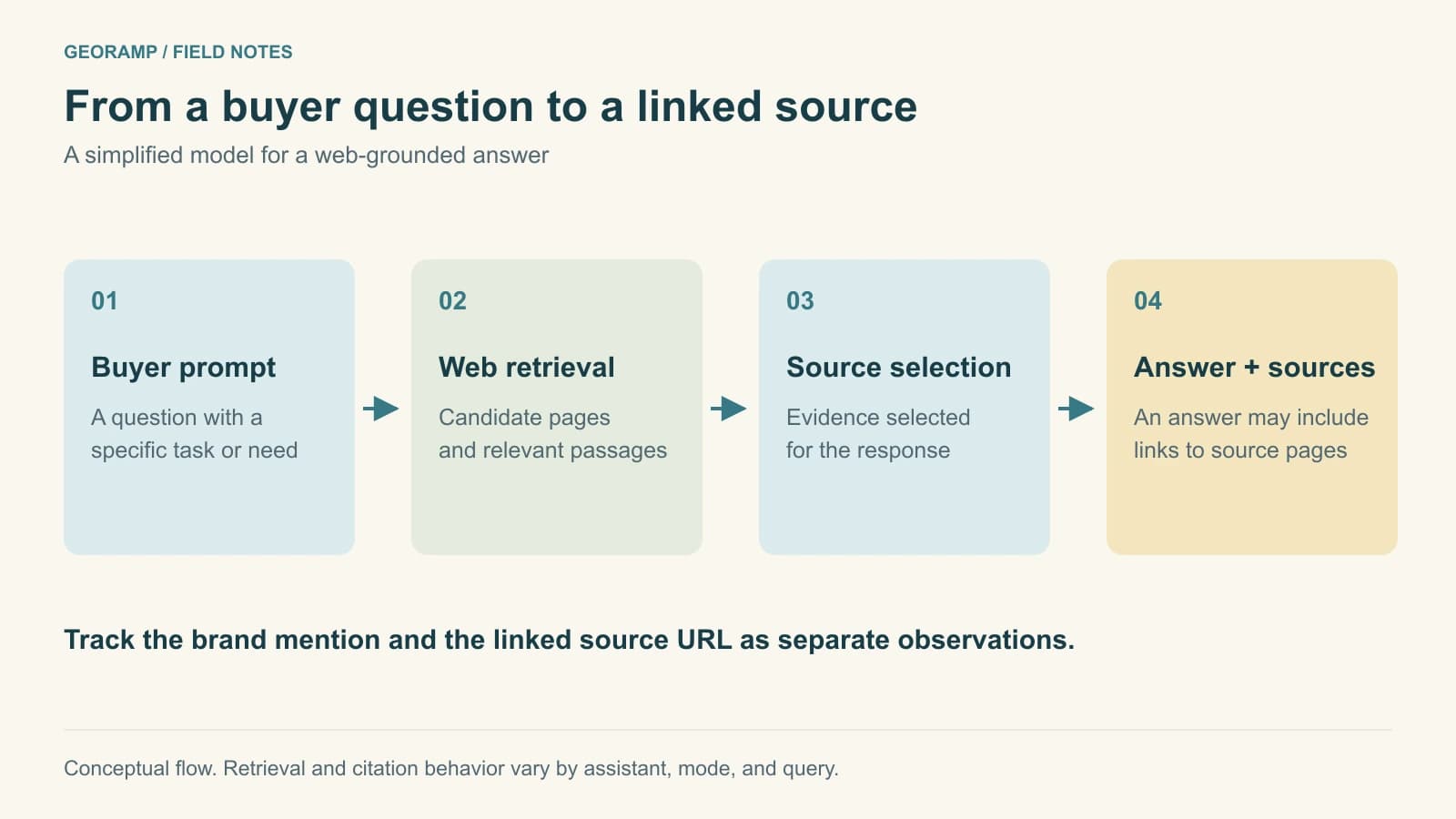
Conceptual flow. Retrieval and citation behavior vary by assistant, mode, and query.
That distinction changes the investigation. If an important page is inaccessible, address access first. If the assistant cites the page but gets a fact wrong, inspect the evidence and surrounding text. If it cites competitors instead, compare what their pages actually answer before deciding you need more content.
Why Citation Tracking Is Useful
Source URLs show where an answer's supporting information came from. That makes them useful for content diagnosis: you can see whether a product page, documentation page, comparison, or independent review is being selected for a particular question.
A brand mention on a third-party page can be valuable too. Record it rather than treating every off-domain citation as a failure. The next action might be correcting an outdated review, publishing missing documentation, or improving a product explanation on your own site.
A citation is not automatically a click, a lead, or an endorsement of every claim on the page. Reporting those outcomes separately keeps the visibility report useful to the team making budget decisions.
Make Source Content Worth Selecting
Start with the buyer's question. A page answering "does this tool support SAML?" should state the supported plan, configuration requirements, and any limitations. A general paragraph about enterprise readiness leaves the reader guessing.
Put the answer next to its evidence
Write a direct answer under the relevant heading, then explain the conditions. Link factual claims to the original documentation, research, or data. When you publish a benchmark, include the sample, method, collection date, and limitations. More numbers are not better if they cannot be checked.
The Generative Engine Optimization paper investigates content changes in an experimental benchmark. It is useful background for testing ideas, but its results do not establish a guaranteed citation increase on today's production assistants.
Keep facts current and specific
Pricing, integrations, product limits, and comparison criteria need explicit scope. Say which plan supports a feature. Date time-sensitive information. Fix contradictory facts across product pages and documentation instead of adding another article that repeats them.
Name the actual author or reviewer where that helps readers assess expertise. Use verifiable credentials and describe firsthand methods only when the work was actually performed.
Check access and ordinary SEO foundations
For Google's AI features, Google's guidance says established SEO practices apply and no special AI schema is required. Keep important content available as text, use crawlable internal links, and ensure any structured data matches the visible page. Eligibility does not guarantee selection.
For a practical editing sequence, use our content optimization guide.
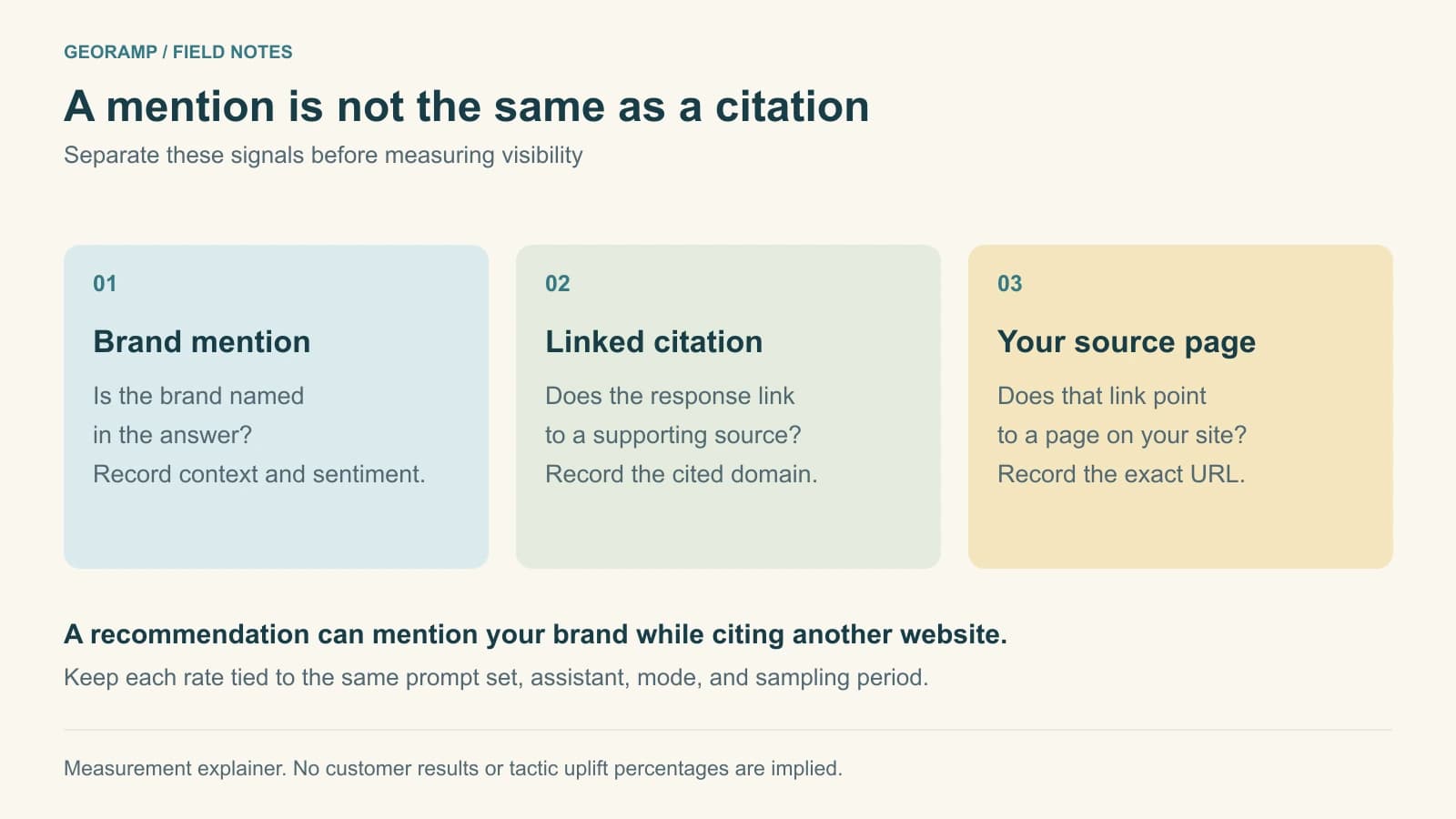
Report brand mentions, linked citations, and citations to your own pages as separate observations.
Build a Citation Report You Can Compare
Choose a fixed set of questions from sales calls, support conversations, and category research. Include different buying situations rather than filling the set with variations of a branded question. Keep branded and unbranded questions in separate segments.
For each collected response, save:
- The prompt and its topic or intent.
- The assistant, model or mode where available, date, and run identifier.
- Whether your brand was named, and whether the description was accurate.
- The linked source URLs, identifying your own domain and third-party domains.
- Retrieval errors or failed runs, which should not silently become negative answers.
Use successful sampled responses as the denominator for an answer-level rate. For example, if 24 of 160 responses link to your domain, your own-domain citation rate is 24 ÷ 160 × 100 = 15%. Count each response once for that rate, even if it links to several of your pages. A separate URL-level table can count every linked page.
Do not call that 15% a competitive share of all citations. Competitors can be cited in the same answer. Our share-of-voice calculation guide explains the denominator difference.
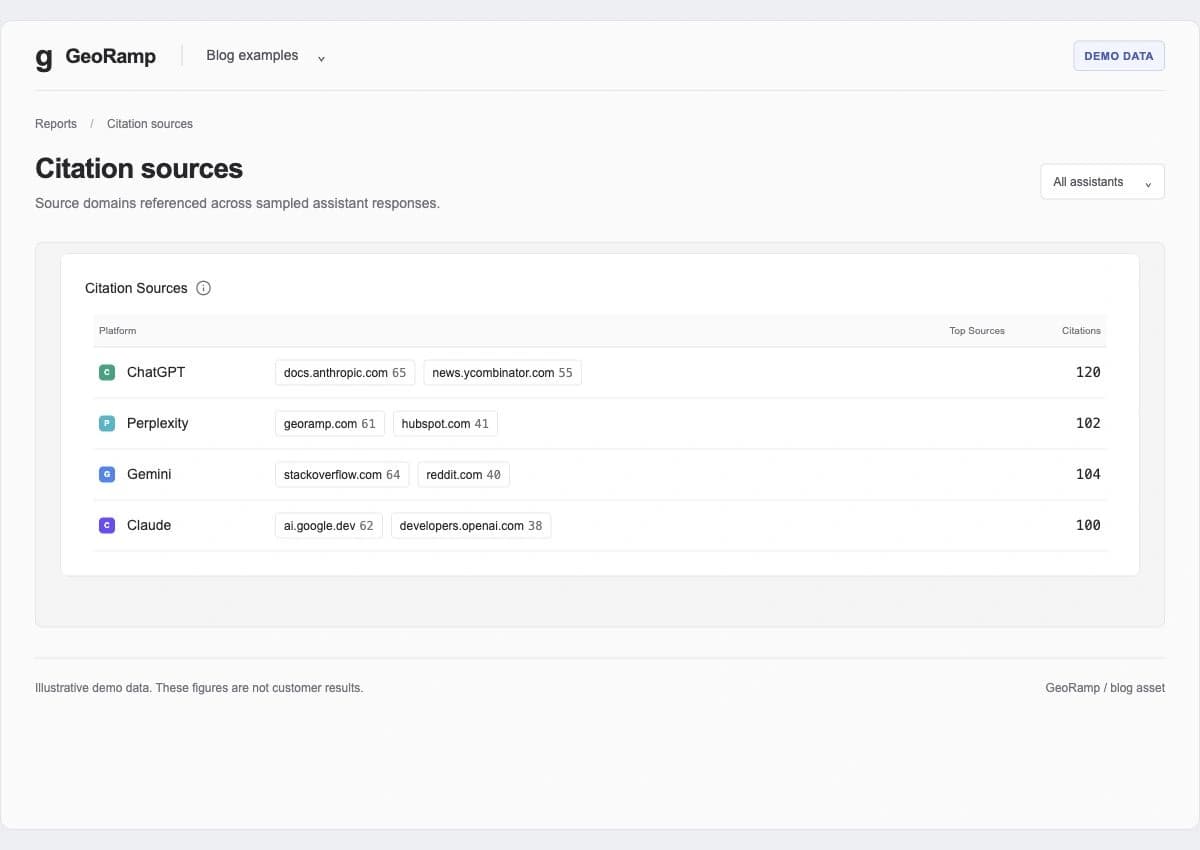
GeoRamp Screenshot Studio widget with seeded demo data. These figures illustrate the interface and are not customer results.
Interpret Concentration Before Planning More Pages
Consider a hypothetical report with 160 successful responses. Your domain is cited in 24, and 19 of those responses link to the same comparison page. That page appears in roughly 79% of your cited responses (19 ÷ 24).
Inspect the questions behind those 19 responses. If they are all comparison questions, the concentration may simply reflect the prompt set. If the sample covers many product and implementation questions, check whether other pages provide sufficiently specific answers. The count alone does not prove the site is fragile or that a new content hub will increase citations.
Choose a small set of edits, save the previous version, and collect another comparable sample. Keep the prompt mix and collection settings stable. Look at repeated runs, source URLs, and referrals together. A single better answer is a useful observation, but it does not establish that an edit caused the change.
Check your brand's AI visibility
Use GeoRamp to investigate brand mentions and the source pages linked in AI answers.
Check my visibility →

