


An assistant cannot give a reliable account of your product if your own pages disagree about the supported integrations. Start product visibility work with facts a buyer can verify, then measure whether the relevant answers reflect them.
These checks are a practical backlog, not a ranking of guaranteed citation gains. Choose the items that address a documented gap in your product's source material.
1. Make the product identity unambiguous
State the product name, category, intended user, and primary job in plain language. Explain ambiguous acronyms and distinguish the company from similarly named products. Use the same core naming across important pages.
2. Publish the details that decide fit
Document supported environments, integrations, plan limits, and exclusions. Separate an available capability from a roadmap item. A buyer should not need to infer a technical requirement from a marketing slogan.
3. Check public-page access
Inspect status codes, canonical URLs, indexing directives, and essential page text. If a key fact only appears after interaction, test the implementation rather than assuming it is readable by every retrieval system.
4. Answer recurring evaluation questions
Use actual sales and support questions to identify missing explanations. Keep a direct answer near the relevant heading and attach the conditions that make it accurate. The AEO guide explains how to write a question-to-page brief.
5. Make comparisons fair
Compare the same criterion across alternatives. Cite current official sources for competitor capabilities and avoid invented scores. Explain who each option suits and where a reader should verify a changing detail.
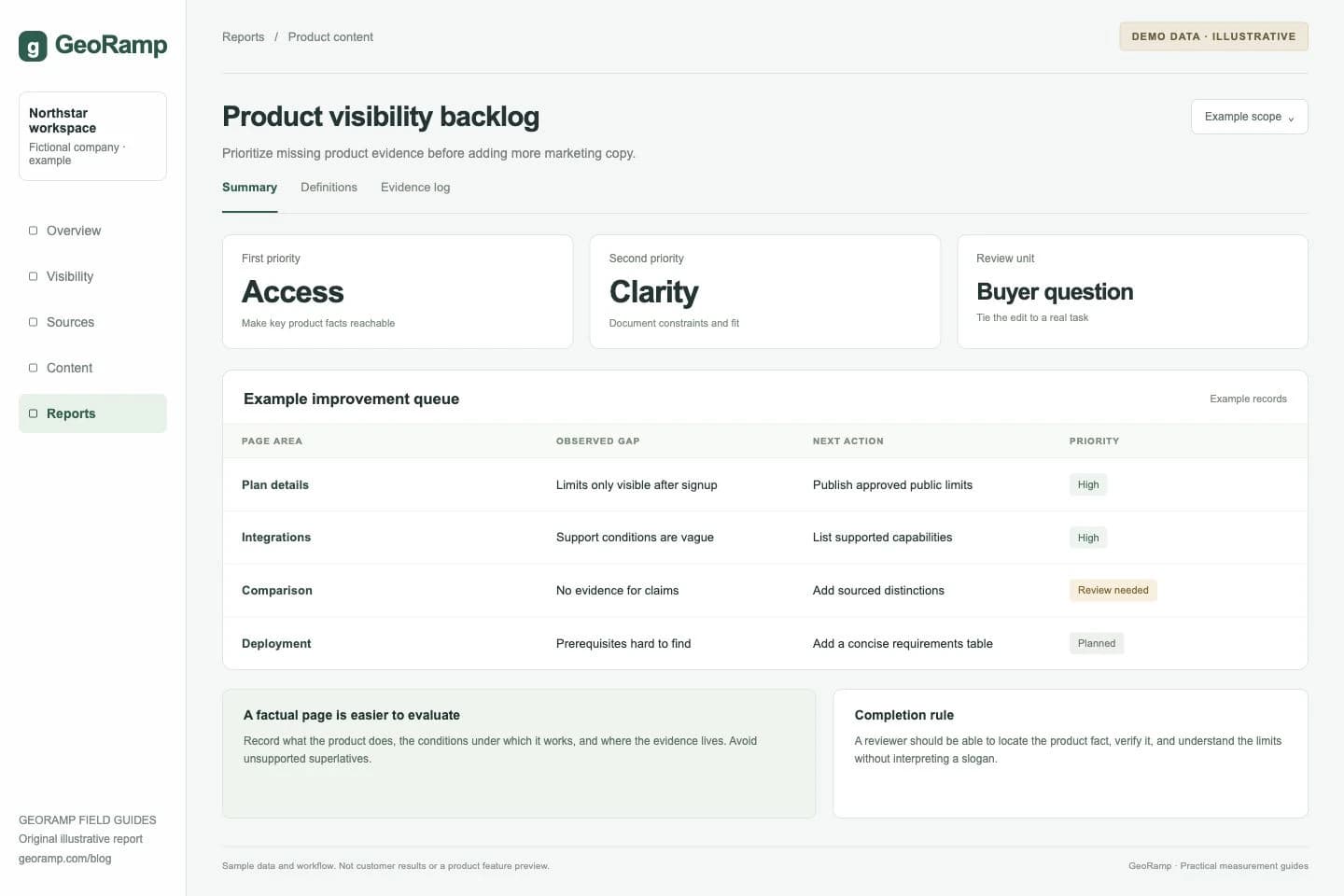
Illustrative report with fictional data and workflow examples. This is not a customer result or a preview of a specific product screen.
The illustrative backlog shows tasks, owners, and evidence to collect. Its priority labels are editorial judgments, not measured predictions of citation uplift.
6. Support empirical claims
Show the method, date, sample, and source for an original measurement. Link primary evidence for external claims. Do not turn a hypothetical example into a case study by replacing “example” with “customer.”
7. Keep markup and visible facts aligned
Use structured data that accurately describes the page and is appropriate for its content. Validate it after changes. Do not add unsupported ratings or capabilities to markup because they are easier to hide there than in the visible copy.
Google's AI features documentation does not prescribe a special AI schema or new AI text file as a requirement for inclusion. Treat a proposed file such as llms.txt as a separate implementation choice, not a replacement for accessible pages.
8. Improve internal routes to the answer
Link product pages to relevant implementation guides, comparisons, and pricing explanations. Use descriptive link text. A useful content structure lets visitors move from a broad question to the details without searching the entire site.
9. Maintain external source accuracy
Review important business listings, integration directories, and partner descriptions for stale facts. Correct information through the normal process where you have a legitimate role. Do not manufacture reviews or flood communities with promotional mentions.
10. Repeat a stable measurement
Save a baseline prompt set and its collection conditions. After publishing a change, repeat the same observations and inspect the sources behind any movement. Track mentions, citations, and identifiable referrals as separate events.
Use a small change log with the page, reason, owner, release date, and review date. If several things changed at once, say so when interpreting the results. The AI SEO strategy guide shows how to organize this work into a manageable program.


