


The short answer
- Evaluate an AI visibility agency against a written scope: named outputs, implementation owners, acceptance checks, and access to the evidence.
- Buy a bounded audit or specialist task when your team can execute. A recurring retainer needs recurring work and someone able to approve and ship it.
- Use the scope worksheet to separate delivered advice, approved content, and verified live changes. A citation increase is an observation, not a deliverable an agency can guarantee.
An AI visibility service provider can deliver a polished citation report every month while nobody changes the pages behind it. Before hiring an AI visibility service, decide who will implement the findings and how you will inspect the work.
The best provider for a team depends on the bottleneck: measurement, specialist writing, technical fixes, or ongoing execution. A list of agency names is less useful than a scope you can use to evaluate actual proposals.
Define the service you need
If your team can write and ship but lacks a reliable measurement process, buy a bounded audit or monitoring setup. If the team understands the gaps but cannot produce technical documentation, prioritize subject expertise and editorial capacity.
If changes require engineering, establish whether the provider will implement them, prepare tickets, or simply advise. A recommendation to improve rendering has little value when neither side owns the deployment.
Separate one-time discovery from recurring work. The initial question set, baseline, and site review may deserve a project fee; repeated observation, content maintenance, and reviews may fit a retainer.
For a small question set, an in-house marketer can begin with a manual answer log and a review of existing search data. Buy help when diagnosis, writing, technical work, or the recurring review exceeds the team's capacity. A software subscription supplies a measurement workflow; it still needs someone to carry out the decisions.
Request concrete deliverables
Ask for an anonymized sample that the provider is entitled to share. It should show the question set, collection conditions, raw evidence, interpretation, and the action that followed. A screenshot of a rising line is not enough.
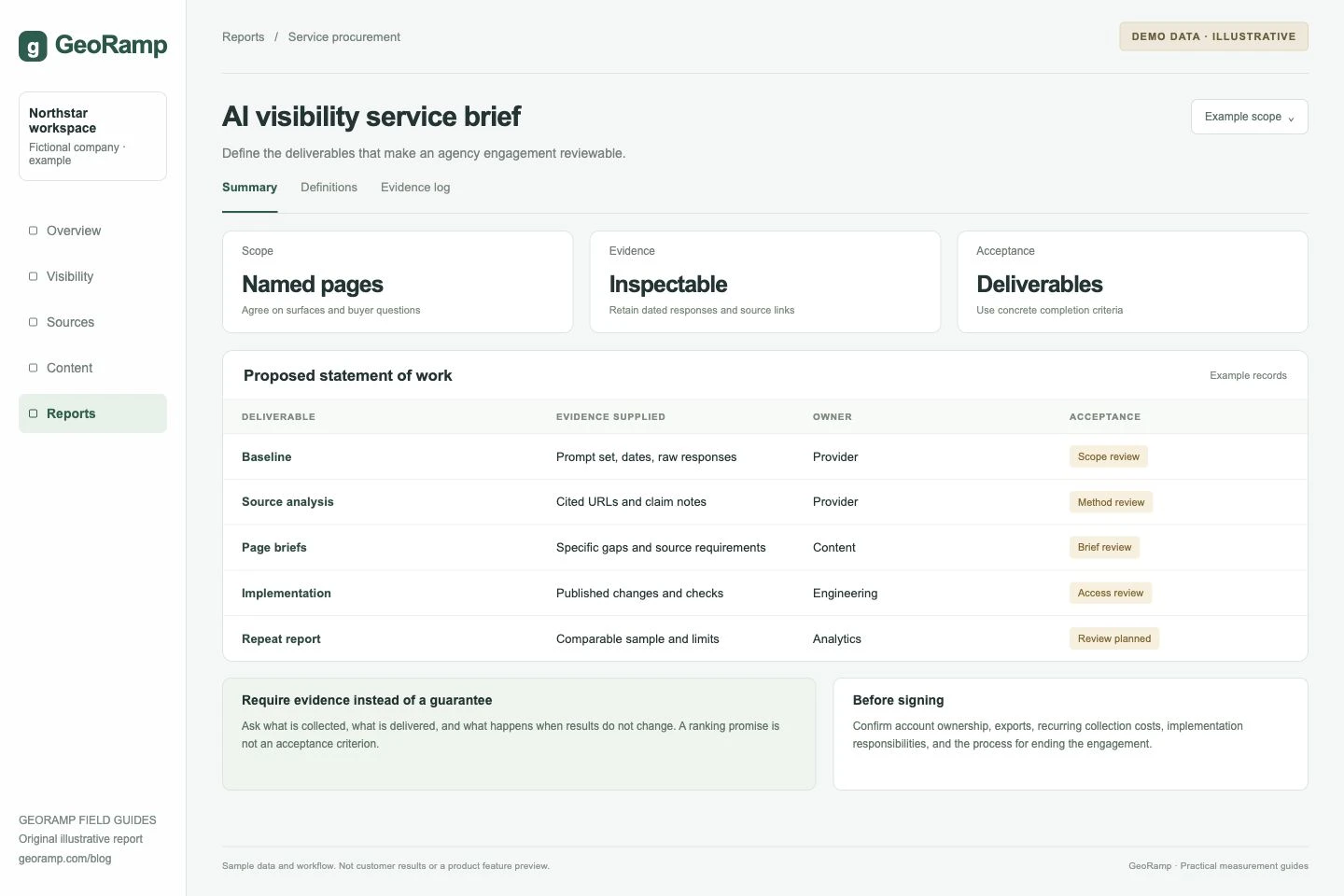
Illustrative report with fictional data and workflow examples. This is not a customer result or a preview of a specific product screen.
The example service brief includes a baseline, source review, prioritized page briefs, implementation responsibilities, and a review of the repeated sample. It is a proposed scope, not a claim about any named agency.
Every recommendation should link to its evidence and name its assumptions. If a provider says a content format caused a citation increase, ask how other changes and sampling variation were considered.
Turn the proposal into an acceptance worksheet
Give each finalist the same brief and ask them to fill in the quantities, owners, exclusions, and review dates. “AI optimization” is too broad to accept as a finished task. An audit, a content brief, an approved draft, and a deployed page are separate outputs.
Download the filled scope and acceptance example or blank scope worksheet. Open either CSV in Excel or Google Sheets. The example is fictional, with invented review statuses. Its quantities are choices for this exercise, not recommended minimums or a standard agency package.
Here is a compact version of the example. The download also records the evidence to retain, both sides' owners, dependencies, and change rules.
| Agreed output | Acceptance check | Example review status |
|---|---|---|
| One baseline on 12 approved questions, two named surfaces, English, US | Inspect dated answers, cited URLs, collection method, and failed runs | Accepted |
| Two page briefs | Each has a buyer question, evidence, proposed change, and client approver | Accepted |
| One revised integration page | Product owner approves factual claims and scope | Copy approved |
| One deployment and live check | Approved copy is live at the existing URL, with its canonical and relevant links checked | Blocked: client CMS release |
| One review of the unchanged sample | Compare like-for-like observations and list unresolved limits separately from visits or enquiries | Scheduled after release |
| One handover pack | Client can open the question list, evidence, final copy, and change log without the provider's account | Pending handover |
Use the prompt selection worksheet when agreeing on the question list. Have the provider name the actual surface and mode for each collection route. An API response and a signed-in consumer session should not be presented as interchangeable observations.
Agree who reviews each output and how many revision rounds the fee includes. Record a due date and a written reason when an acceptance check fails. A changed market, additional page, or expanded question set should have an explicit scope and cost decision before work starts.
Work through a blocked release
In the fictional example, the agency has delivered two usable briefs and the product owner has approved the revised integration copy. The client's CMS release has not happened. Accept the briefs and copy against their own checks, while leaving deployment open. The change log should name the client release owner and the next review date.
Do not report that the page has been optimized in production, or interpret the next visibility sample as a result of an edit that is still private. If the provider was hired to deploy as well as write, ask for the dependency and revised delivery plan. If deployment belongs to your team, give that owner an explicit handoff instead of commissioning more copy while the first change waits.
At the first delivery review, continue when the agreed outputs are usable and the next work has an owner. Narrow the engagement when the diagnosis is useful but implementation capacity is limited. Pause recurring production when nobody can approve or release it. Those are delivery decisions; they do not require a promised uplift to make sense.
Compare delivery models
| Model | Useful when | Question to settle |
|---|---|---|
| In-house owner | Product context and implementation are tightly linked | Who has time to maintain the program? |
| Specialist freelancer | The missing task is well defined | Who coordinates adjacent work? |
| Agency | Several capabilities and recurring delivery are needed | Who does the actual work and who approves it? |
| Advisory engagement | Your team can execute but needs diagnosis | What written output makes the advice actionable? |
Check who will attend reviews, write the content, and handle technical escalation. The people in a sales meeting may not be the people delivering the engagement.
Price the workload rather than an acronym
Request quotes against the same number of products, markets, prompt cohorts, source reviews, and content deliverables. Include platform subscriptions, implementation, review rounds, and data retention. If software is billed separately, use the tool pricing and workload checklist to compare that part of the proposal.
Avoid treating a broad market price range as a quote for your project. A program spanning one product and language is a different workload from a multi-brand rollout with approval requirements.
Ask what happens when a platform changes its collection method or a data source becomes unavailable. The scope should explain how that affects the work, rather than hide the loss inside a composite score.
Watch for claims that cannot be tested
Be cautious about guaranteed recommendations by a named assistant, undisclosed customer statistics, fabricated reviews, and large volumes of near-duplicate content. Ask for the evidence behind claimed proprietary access or preferred treatment.
Google's guidance on hiring an SEO recommends checking references, asking for explanations of changes, and beginning an audit with read-only Search Console access. For a Google-specific recommendation, ask how it fits the current guidance on optimizing for generative AI features. These checks do not validate claims about other assistants.
A useful provider can explain uncertainty without avoiding responsibility for the work. It can commit to a method, a quality standard, and deliverables even when it cannot control a search system's output.
Agree on ownership and the exit
Keep access to the prompt list, collected evidence, content, change log, and exportable reports. Define how account access is handled and removed when the work ends. Give your team enough documentation to continue the program.
Use the AI SEO strategy to write the brief and the citation analysis guide to evaluate the provider's reporting method.
Check the measurement tool separately
We make GeoRamp, an AI visibility platform. This guide does not rank agencies or describe a paid agency test. If you already have delivery capacity, our AI visibility tools guide for agencies compares software workflows and free options. It also records collection and reporting limits worth testing before a provider promises a particular client deliverable.
If GeoRamp is on your software shortlist, book a demo with your proposed scope. Ask us to show the evidence and handover your team needs. GeoRamp's provider API samples do not reproduce every consumer-interface experience, and a demo is not an outsourced content or implementation engagement.