
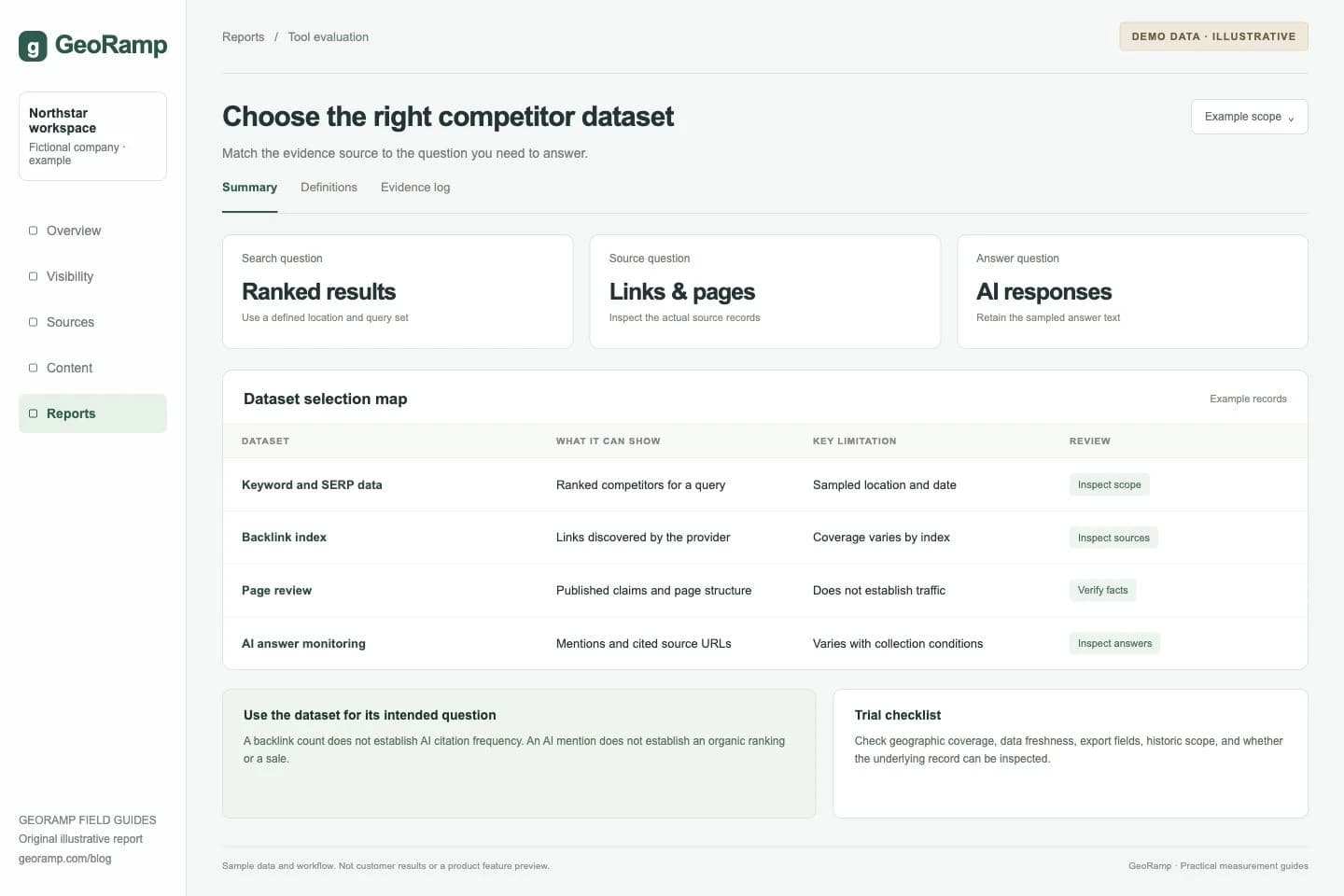

Two tools report different traffic estimates for the same competitor. That does not necessarily mean one is broken. They may use different keyword databases, countries, devices, and estimation models.
Choose competitor analysis tools by the evidence they provide and the decision you need to make. Keep modeled estimates separate from first-party measurements and direct observations.
Match the dataset to the question
| Question | Useful dataset | Important limitation |
|---|---|---|
| Which searches surface competing pages? | Keyword and SERP observations | Coverage and collection dates vary |
| Which sites link to those pages? | Backlink index | An index is not a complete map of the web |
| What does the competing page explain? | Direct page review | Content can change after the review |
| Which answers cite competitors? | Recorded prompt responses and sources | A sample is not all user activity |
| Which content should we improve? | Your inventory plus buyer evidence | Competitor coverage alone does not prove demand |
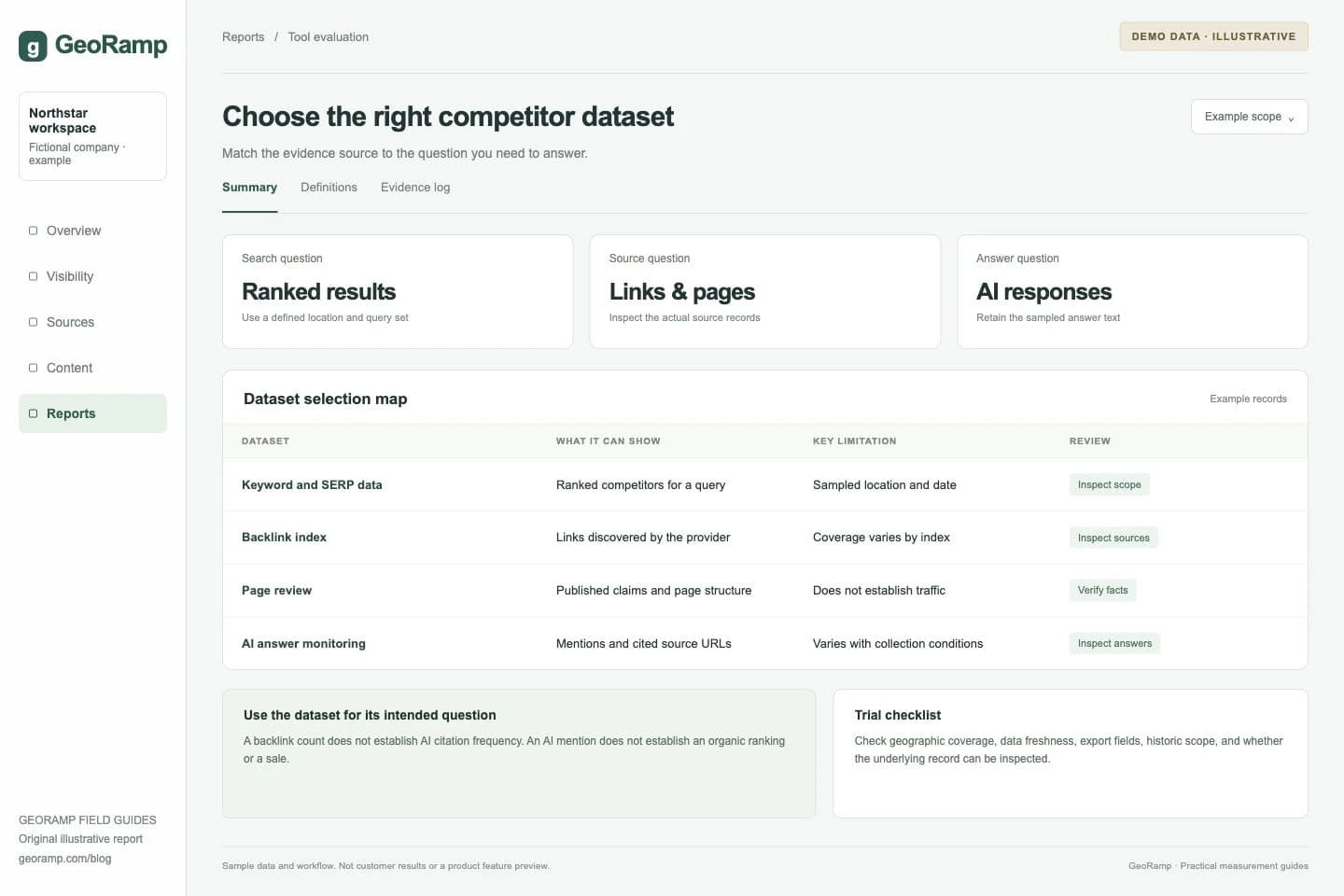
Illustrative report with fictional data and workflow examples. This is not a customer result or a preview of a specific product screen.
Use conventional SEO suites for search discovery
Ahrefs and Semrush provide established keyword, link, and competitive research workflows. Their AI products also add generated-answer observations: Ahrefs Brand Radar and the Semrush AI Visibility Toolkit.
When evaluating either, check the exact dataset, refresh cadence, geography, and export limits relevant to your work. Do not assume a broad database and a custom prompt cohort use the same collection process.
Use estimated traffic to identify pages worth inspecting, not as a substitute for a competitor's private analytics. Round estimates appropriately and avoid presenting them as audited revenue or visits.
Add content analysis when prioritization is the bottleneck
Tools such as MarketMuse support content planning and topical analysis. Editorial systems such as Clearscope can assist with research and optimization.
Test whether their suggestions help you make a better decision about an actual page. A longer list of missing terms is not automatically a better brief. Product expertise, user intent, and source quality still need review.
Add answer monitoring when the question requires it
A dedicated AI visibility workflow should let you inspect the answer, source URL, and collection conditions behind a brand score. GeoRamp is one option; the broader AI SEO tools comparison includes alternatives and related categories.
Ask whether collection uses a consumer interface, an API, or a provider's existing index. Establish what a failed run looks like in the report and whether you can retain your original prompt history.
Run a shared evaluation task
Choose a small competitor set and a real buying topic. Ask each shortlisted tool to identify relevant pages, explain its metric, and export the underlying observations. Then manually inspect several findings.
Record setup time, evidence quality, workflow fit, and cost at your expected usage. A tool that makes one important task reliable can be more useful than a broad suite whose outputs nobody can explain.
Avoid buying overlapping subscriptions before testing the reports you already have. Add a dataset when it answers a distinct question, and revisit the choice when your workload changes.
Use the content gap analysis template to turn the findings into page briefs. The competitive intelligence guide covers how to maintain the evidence over time.


