
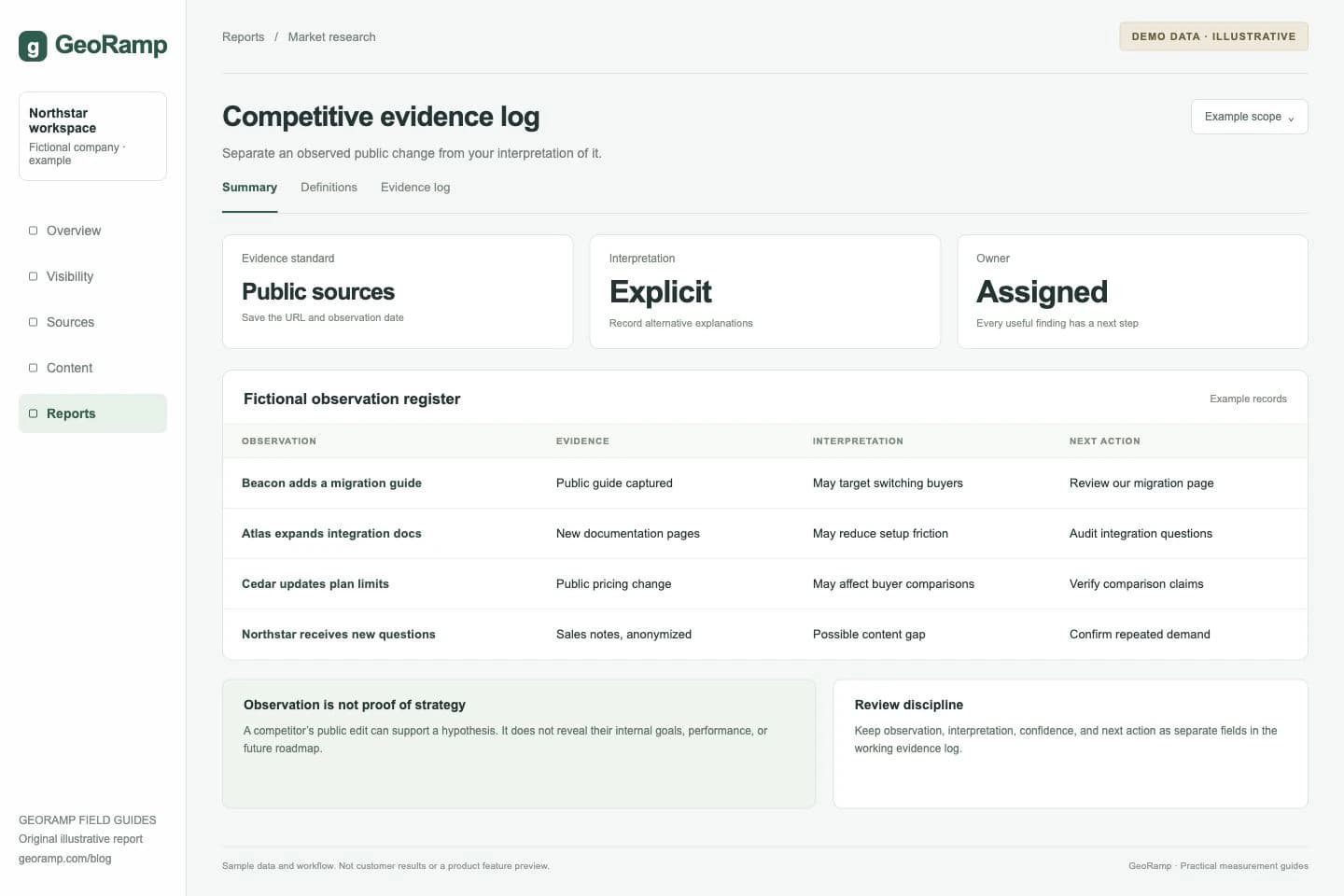

A competitor changes a pricing page. One person forwards a screenshot, another says the company is moving upmarket, and sales repeats the interpretation as fact. A competitive intelligence process should keep those statements distinct.
The job is to collect reliable observations, form explicit hypotheses, and help someone make a decision. More alerts are useful only when the team can interpret and act on them.
Start with intelligence requirements
Ask product, sales, and marketing which recurring decisions lack evidence. Examples include whether an integration has become common in evaluations, whether a competitor's packaging changes affect objections, or whether a new source influences discovery.
Turn each need into a specific question with an owner. “Monitor competitors” is open-ended. “Review public changes to deployment options before the next positioning update” creates a manageable scope.
Choose a cadence based on the decision. A launch response may need a quick review; a quarterly positioning decision rarely needs daily notifications about every blog post.
Keep an evidence ledger
Store the source URL, capture date, observed fact, affected product, and confidence. Preserve the exact wording where a small qualification changes the meaning. Use public and legitimately accessible sources.
Add separate fields for interpretation and proposed response. An announced feature may be in preview, limited to a plan, or unavailable in a relevant region. Read the conditions before claiming parity or superiority.
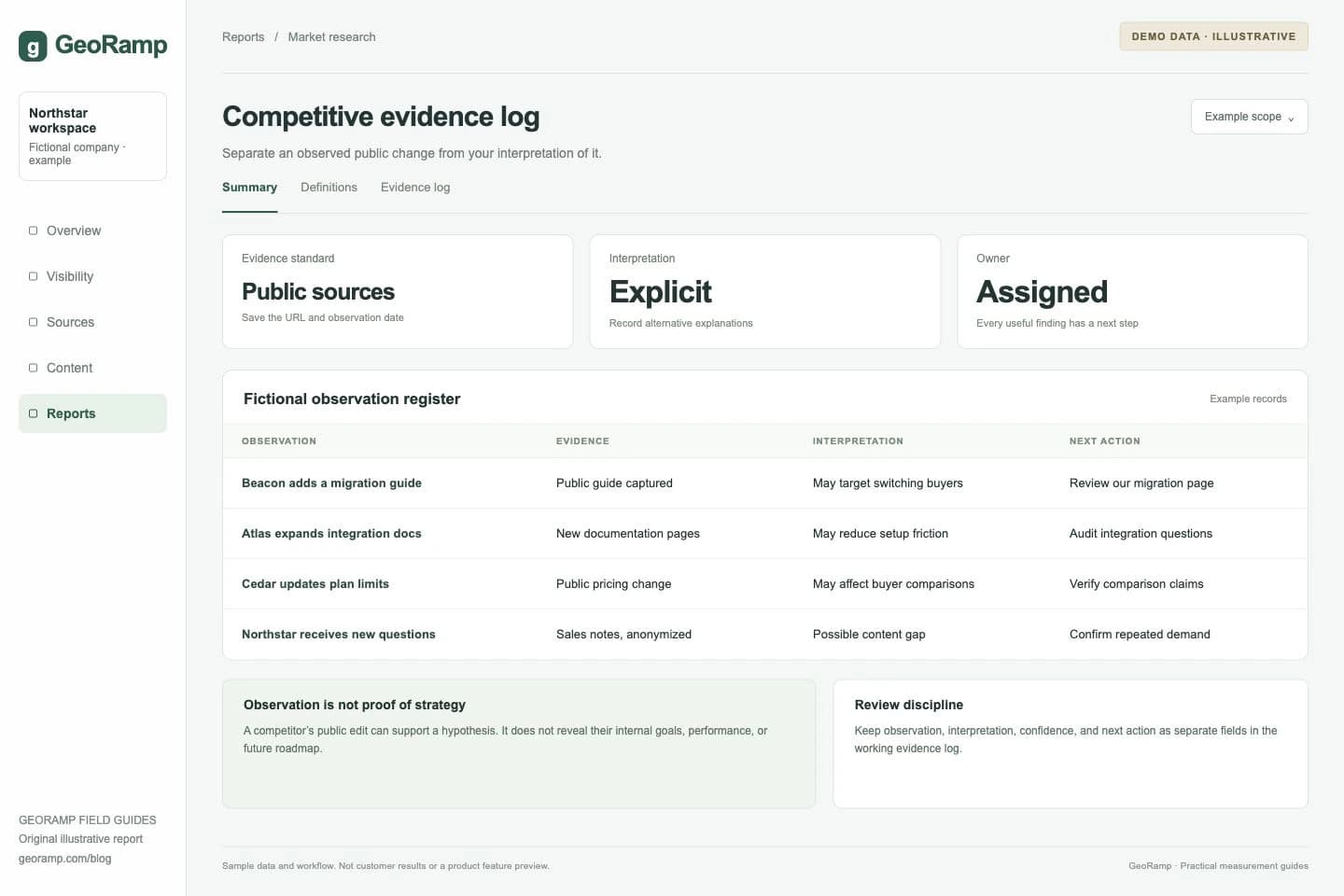
Illustrative report with fictional data and workflow examples. This is not a customer result or a preview of a specific product screen.
The example ledger uses fictional companies and illustrative entries. It shows how a public observation can lead to a hypothesis and a follow-up task without presenting speculation as a confirmed market fact.
Combine external observations with internal feedback
Sales notes can explain whether an external change matters to buyers. Support requests can reveal a practical requirement that competitor messaging exaggerates or understates. Product knowledge can distinguish a superficial claim from a meaningful capability difference.
These inputs have biases. One sales call is not a representative market survey. A handful of highly vocal customers may not describe the broader audience. Record the source and volume of feedback instead of stripping away that context.
Use AI search observations carefully
Track whether generated answers describe your category and product accurately. Preserve the prompt, assistant, mode, date, answer, and source URLs. A single response can be wrong or unstable, so repeat important observations before escalating them.
If an answer cites an outdated page, the action may be a source correction. If multiple answers reflect a genuine product limitation, the response may belong in positioning or product planning rather than a content rewrite.
The citation analysis guide explains how to inspect these source patterns.
Deliver a brief that supports a choice
Use a compact format: observed change, evidence, relevance, confidence, recommended action, owner, and next review. Include a “no action” option when the evidence does not justify a response.
For sales enablement, translate verified facts into accurate qualification questions. Avoid battlecards that rely on stale criticism or omit meaningful tradeoffs. Give every externally sensitive claim a source and an expiry date.
Review the usefulness of the system
Track whether intelligence changed a decision or prevented a mistake. Remove feeds that produce noise without improving the work. Revisit the questions when your product, audience, or competitive set changes.
For a periodic marketing assessment, use the competitive analysis guide. For the software supporting collection and discovery, see competitor analysis tools.


