

A competitor dominates broad category searches but rarely appears in the integration questions your best customers ask. A single visibility score can hide that difference and send your team toward the wrong content.
Competitive marketing analysis should start with the decision you need to make: which audience to prioritize, which question to answer, or which distribution gap to investigate. The competitor list and metrics should follow that decision.
Define a useful comparison set
Begin with direct alternatives that buyers actually consider. Add indirect options, such as a manual workflow or a broader platform, when they appear in real evaluations. Keep publishers and review sites in the search analysis when they compete for attention, even if they do not sell a competing product.
Document why each entity is in the set. A large, famous brand may be a useful reference without being an appropriate benchmark for every product segment. Review the list when the market or your positioning changes.
Compare each channel on its own terms
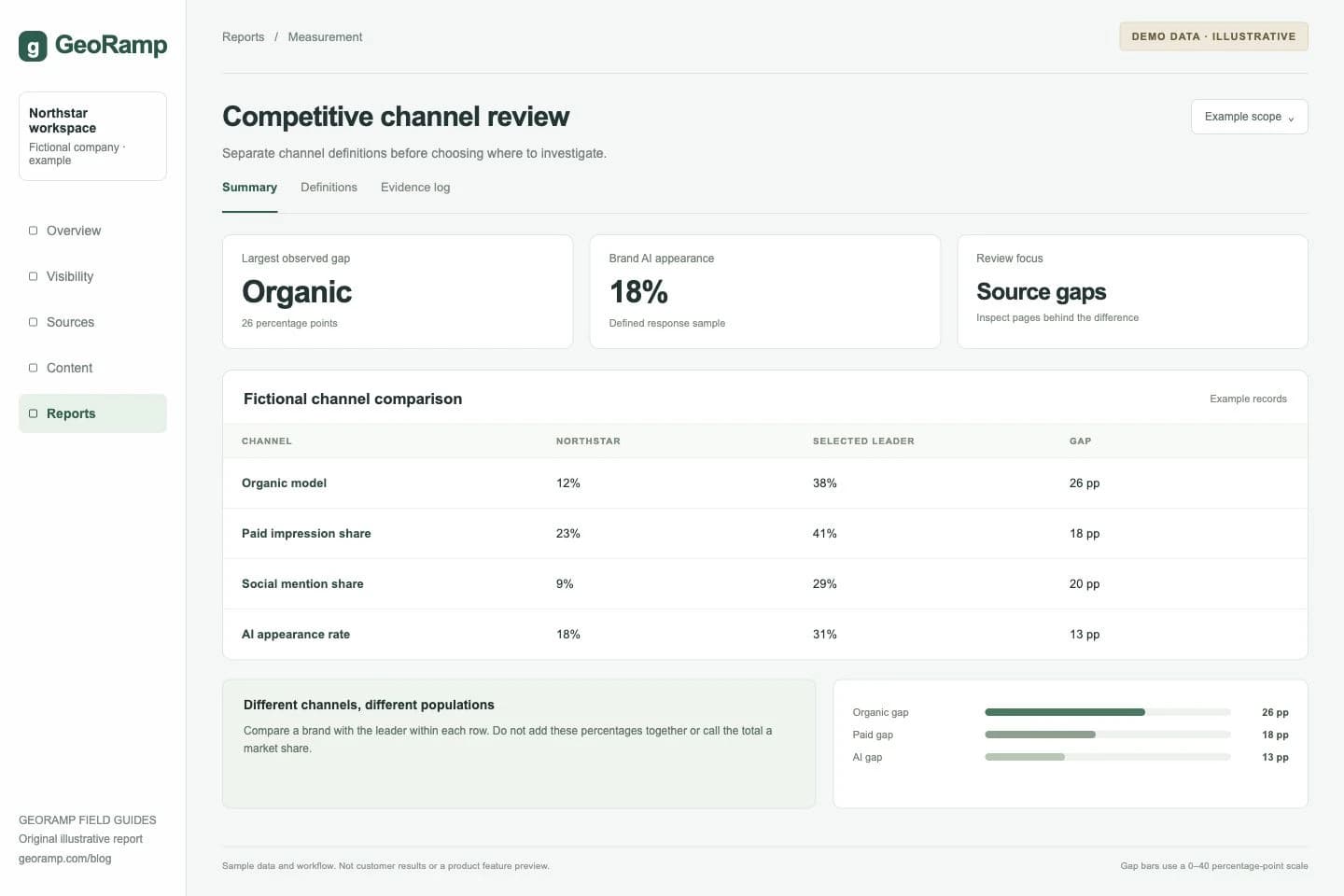
Organic visibility estimates depend on the keyword set and weighting model. Paid impression share depends on eligible auctions. Social mention share depends on the monitored sources and matching rules. AI appearance rates depend on the sampled responses.
Keep these rows separate. Do not add their raw counts or call a weighted average “market share.” If you create an internal planning index, disclose the weights and retain the original measures underneath it.
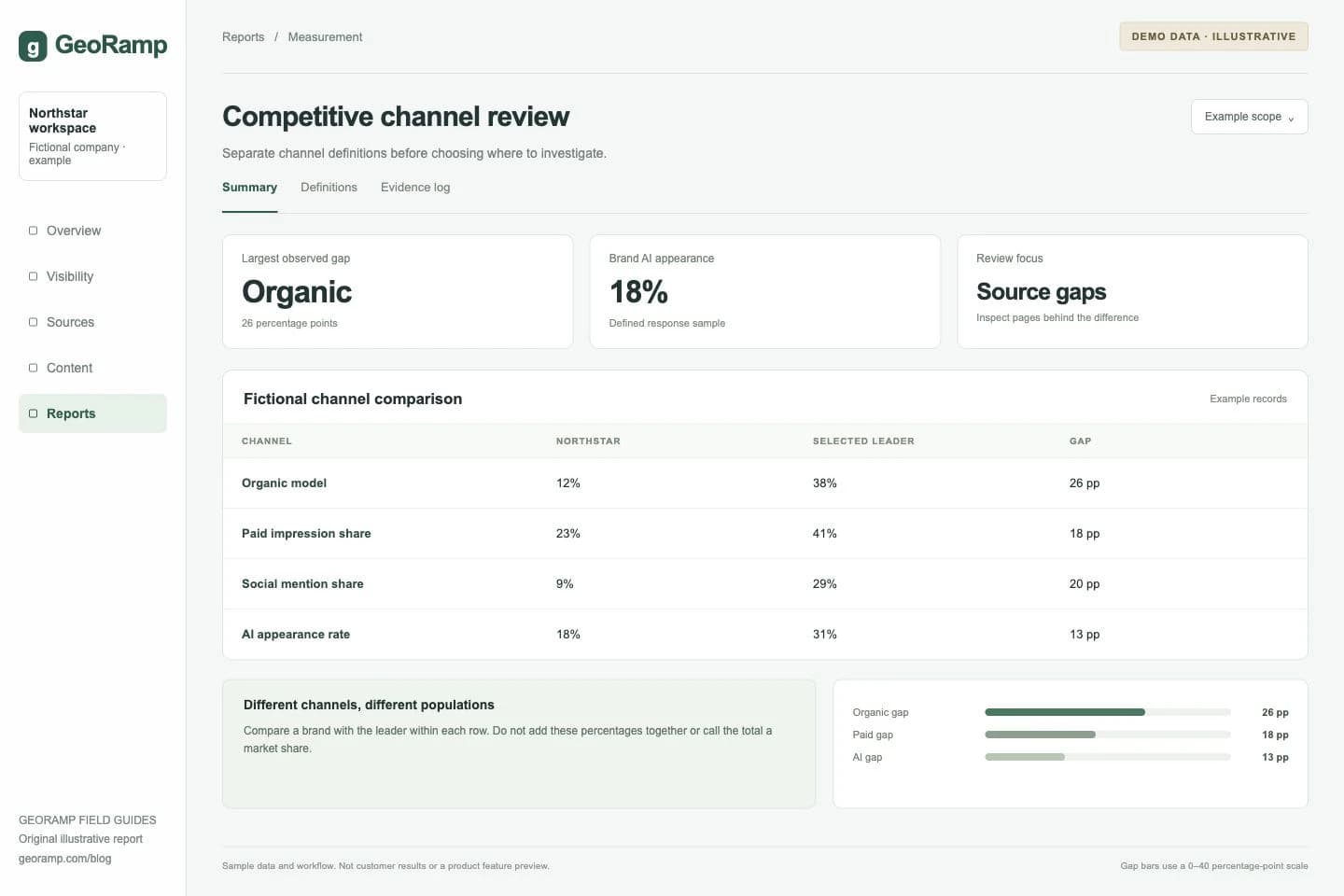
Illustrative report with fictional data and workflow examples. This is not a customer result or a preview of a specific product screen.
The illustrative report shows a brand and a comparison leader across several channels. Each row uses its own denominator. The gap helps select an investigation; it does not measure the revenue available to capture.
Read the pages and messages behind the gap
For an organic gap, inspect the actual result and the page's purpose. Is the competitor answering a question you do not address, or serving a different audience? For an AI citation gap, inspect the linked source and the answer it supports.
For paid activity, review the visible offer and landing-page experience. Do not infer a competitor's profitability from the presence of an advertisement. For social conversation, inspect sentiment, relevance, and duplicate mentions before treating volume as demand.
Keep observations and interpretations in separate columns. “The page documents three deployment options” is an observation. “Buyers prefer this vendor because of deployment flexibility” requires additional evidence.
Prioritize a response you can justify
Evaluate the buyer relevance, evidence strength, implementation effort, and likely learning value of each proposed action. Use a short written rationale rather than an unexplained score.
A useful task might improve an existing migration guide, clarify a comparison page, or test a partner distribution channel. Avoid copying a competitor's entire content inventory because a keyword tool finds overlap.
Assign an owner and a review date. Record what would make you continue, revise, or stop the action. A report without that decision rule tends to become a recurring collection exercise.
Maintain a dated evidence file
Save the source URL, observation date, relevant excerpt or screenshot, and collection conditions. Mark facts that need rechecking before they appear in public comparison content.
Use the competitive intelligence workflow for ongoing monitoring. Use the content gap template for editorial work and the marketing share-of-voice guide for an executive view of the channel measures.


