


An assistant can answer a question from model knowledge, retrieve web pages, use a supplied document, or combine several sources. Calling every response “LLM search” hides which of those processes actually happened.
An LLM search experience combines language-model capabilities with information retrieval and an answer interface. The product, mode, tools, and question affect what it retrieves and what evidence the user can inspect.
Separate the model from the search system
The model generates and interprets language. A retrieval component finds information. An interface presents the answer and may display links. These components can change independently.
For example, Google describes retrieval and query fan-out in its generative Search guidance. That explanation helps orient one system; it should not be treated as a complete diagram of every assistant.
Record whether web search was enabled when observing a response. A citation-free answer generated without retrieval should not be pooled uncritically with a search-enabled answer that displays source links.
Follow the evidence you can observe
Store the question, mode, response, and visible sources. Open a cited page and confirm that it supports the claim. A link's presence does not prove the surrounding answer is accurate or that the source was interpreted correctly.
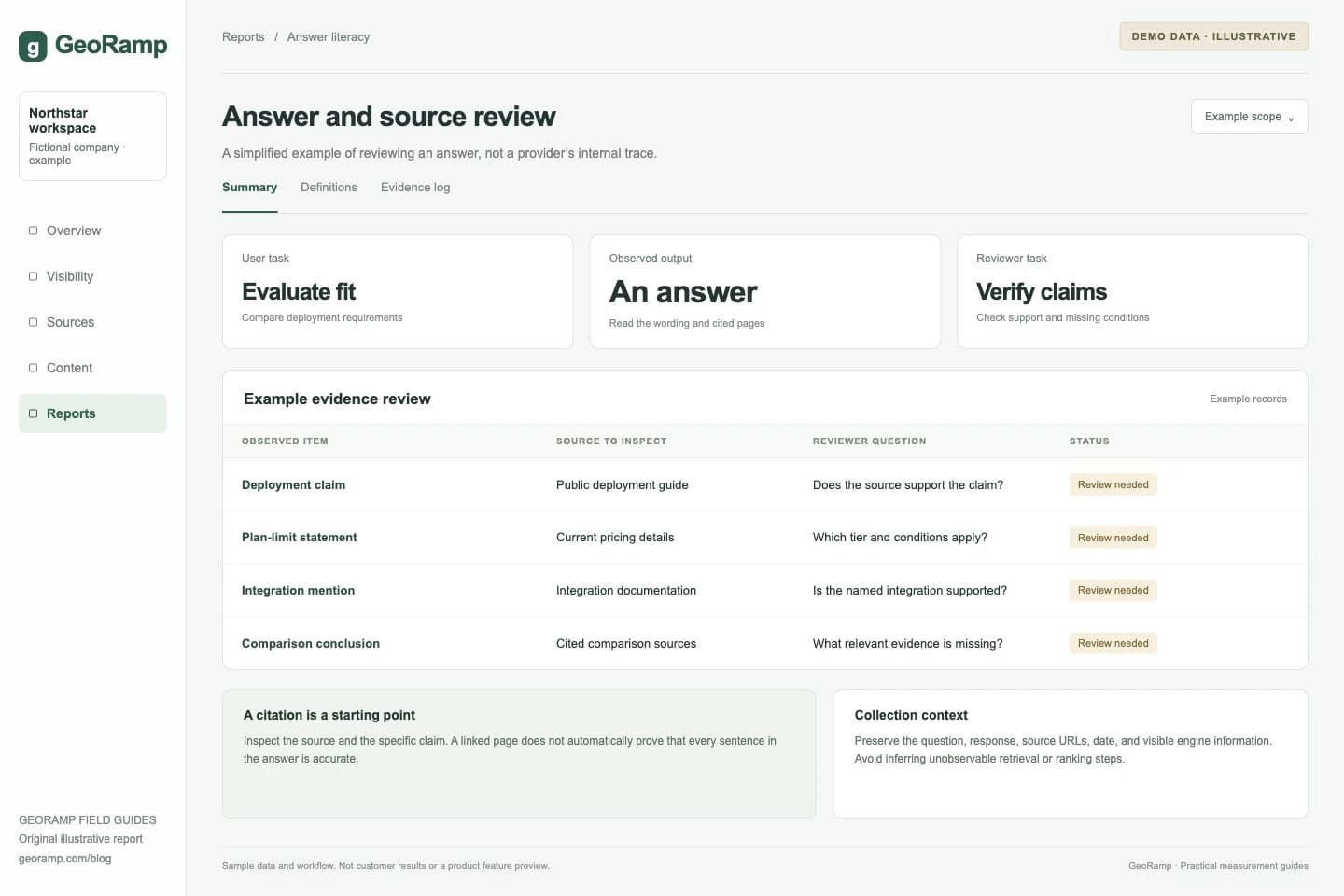
Illustrative report with fictional data and workflow examples. This is not a customer result or a preview of a specific product screen.
The example inspection record separates the requested task, retrieved-source evidence, visible answer, and reviewer checks. It is a conceptual workflow with sample content, not an internal trace from a commercial assistant.
Understand why responses can vary
A question may be interpreted differently across runs. Search results and source pages change. An assistant may use different tools, context, or personalization. A provider can also change the underlying system.
Keep repeated observations when the decision is important. Avoid presenting one favorable answer as a stable ranking. Record a measurement break when the collection method changes.
The AI rank tracking guide explains how to preserve those conditions in a practical report.
Make your public source material useful
Document facts a buyer needs to decide: what the product supports, its limits, relevant examples, and where a claim comes from. Keep those facts consistent across product, pricing, and documentation pages.
Use clear headings and an appropriate format. A procedure needs prerequisites and steps. A comparison needs consistent criteria. A numerical claim needs units, dates, and a source.
Avoid treating “more authoritative tone” as a substitute for evidence. Confidently phrased ambiguity can still be ambiguous, and unsupported detail can make a source worse.
Check access without confusing it with selection
Inspect public-page status codes, essential content, and relevant crawler controls. OpenAI documents different crawler purposes, including search and training. Check the provider's current guidance rather than assuming one bot setting controls every use.
A successful fetch establishes access under the tested conditions. It does not establish indexing, retrieval for a particular question, or selection as a cited source. Keep those stages separate when diagnosing a missing citation.
Measure the outcome you care about
If the goal is accurate product description, review answer correctness. If the goal is discovery, track brand appearances and citations in a defined sample. If the goal is acquisition, examine identifiable referrals and qualified buyer feedback.
These measures can inform each other without becoming interchangeable. Use the GEO guide for a content improvement cycle and citation analysis for investigating selected source pages.


