


A page can be indexed, rank for a relevant query, and still never be cited in your sampled AI answers. Generative engine optimization starts by inspecting that gap instead of assuming an organic ranking and an answer citation are the same event.
GEO is a common label for work intended to improve visibility in generated answers. It covers source quality, technical access, content clarity, and measurement. The label does not imply access to a universal set of proprietary ranking rules.
Understand the source-to-answer process
A search-enabled assistant may interpret a question, retrieve information, select useful material, and compose a response with links. The actual process depends on the product and mode; some responses do not use live web retrieval at all.
This conceptual sequence helps diagnose problems. An inaccessible page is a different issue from an accessible page that does not answer the question. A brand mention without a link is different from a citation to a page on your domain.
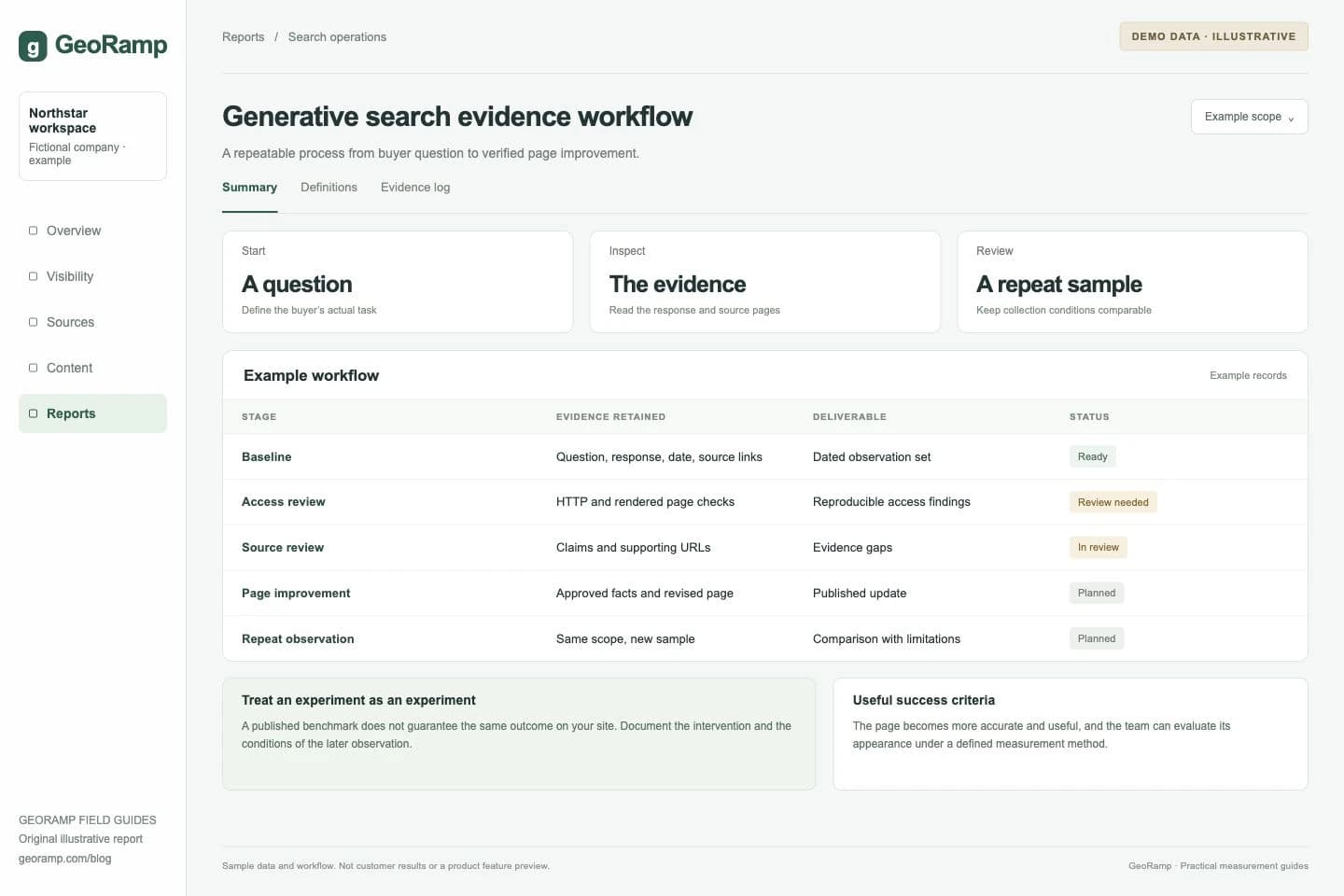
Illustrative report with fictional data and workflow examples. This is not a customer result or a preview of a specific product screen.
The example evidence board maps a buyer question to source review, page changes, and repeated observations. It is a proposed workflow, not a diagram of any provider's internal algorithm.
Read the research within its limits
The GEO paper introduced experimental methods for evaluating source visibility and reported improvements of up to 40% under its tested conditions. Results varied across domains.
Use that work to form hypotheses. Do not convert its headline into a promise that adding citations, statistics, or a more confident tone will produce the same increase on today's assistants. Do not infer a schema benefit or author-credential effect unless the evidence actually tests it.
Our statistics guide explains how to distinguish experimental results, observational studies, and business forecasts.
Build a baseline around buyer tasks
Choose questions from real evaluation conversations. Include discovery, comparison, integration, pricing, and implementation tasks where they matter to the product. Separate branded and unbranded questions.
Record assistant, mode, language, geography where applicable, date, and collection method. Preserve raw answers and source URLs. Keep unsuccessful collections outside the denominator of successful-answer rates and report them separately.
Count brand appearance, owned-page citations, and citation events as distinct measures. The same response can mention several brands, so appearance rates do not need to sum to 100%.
Improve the information behind the answer
Read the cited sources and compare them with your pages. Identify missing facts, unclear limitations, stale references, and weak explanations. Choose the source change that would help a buyer regardless of whether an assistant cites it.
Useful work may include a tested setup guide, an honest product comparison, a clear billing explanation, or an original analysis with a reproducible method. Avoid adding generic paragraphs merely to increase word count or “factual density.”
Keep related pages connected through useful internal links. Give one page a clear role for each underlying intent. Creating many minor wording variations can make the library harder to maintain without helping the reader.
Diagnose access separately
Check public-page responses, canonical URLs, indexing directives, and essential text. Use provider documentation to understand crawler controls. Training permissions and search access are not interchangeable settings across every system.
For Google's surfaces, consult its current generative AI optimization guide. For a page-level diagnostic, use our inspection workflow.
Evaluate the next observation honestly
Maintain a change log and repeat the original sample after publication. Compare the source pages and answer content, not only the headline rate. Record platform changes and sample changes that could affect the result.
A before-and-after movement is not automatically a causal estimate. Use comparable topics and repeated runs where practical, then assess whether the visibility is connected to useful referrals, accurate product descriptions, or qualified discovery.
The AI SEO strategy guide turns this process into an owned backlog and review cadence. The citation analysis guide explains how to investigate the underlying sources.


