
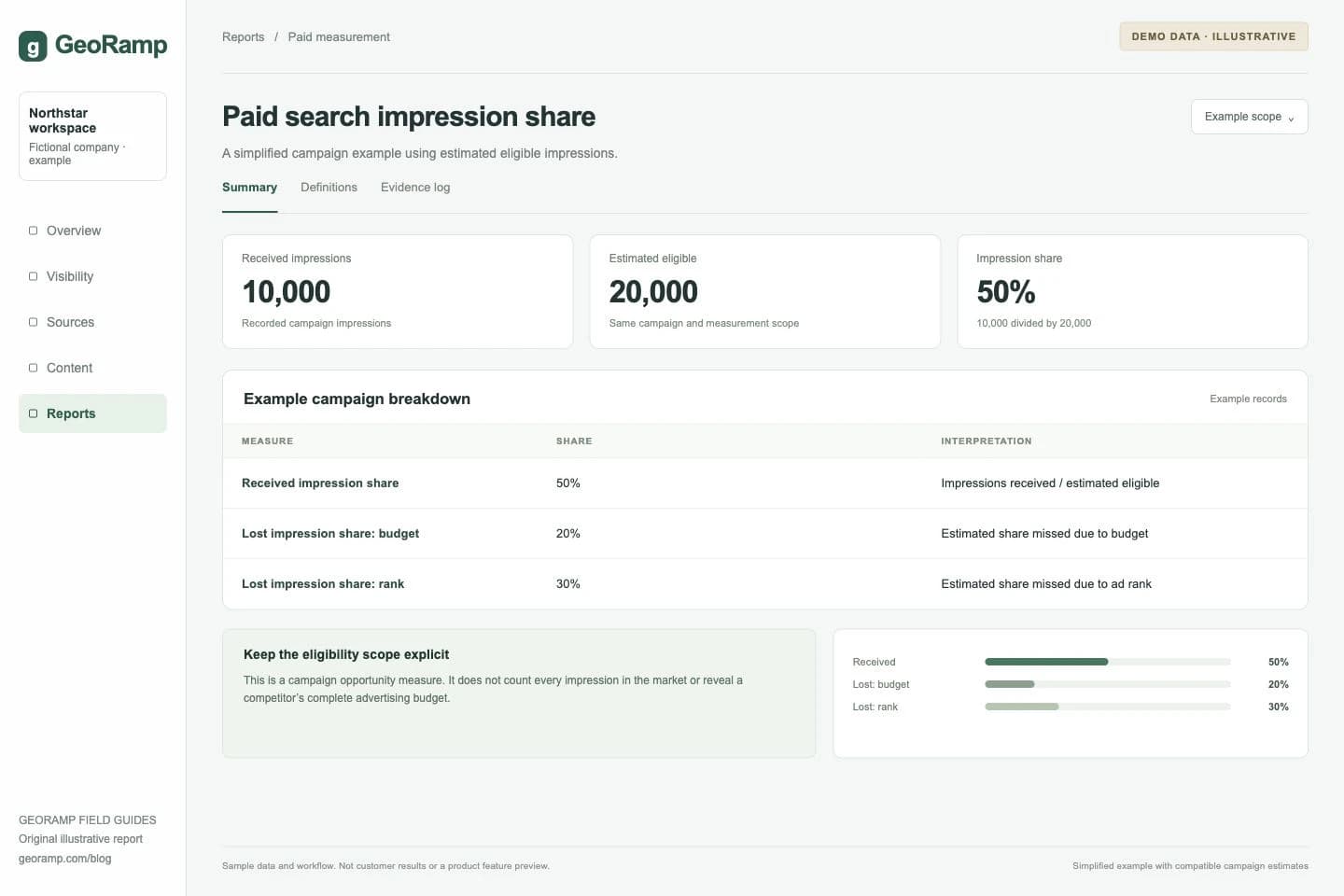

An ad campaign with 50% impression share has not necessarily captured half the category's advertising exposure. It received half of the impressions it was estimated to be eligible to receive under the platform's definition.
That distinction matters before changing a budget. Paid impression share is a diagnostic of auction participation and eligibility, not a complete measure of market attention or profitability.
Use the platform's denominator
Google Ads defines impression share as received impressions divided by estimated eligible impressions. Eligibility depends on factors such as targeting, approval, and quality.
In a simplified fictional example, 10,000 received impressions divided by 20,000 eligible impressions gives 50%. The denominator is an estimate of opportunity under those conditions, not every impression available to every advertiser.
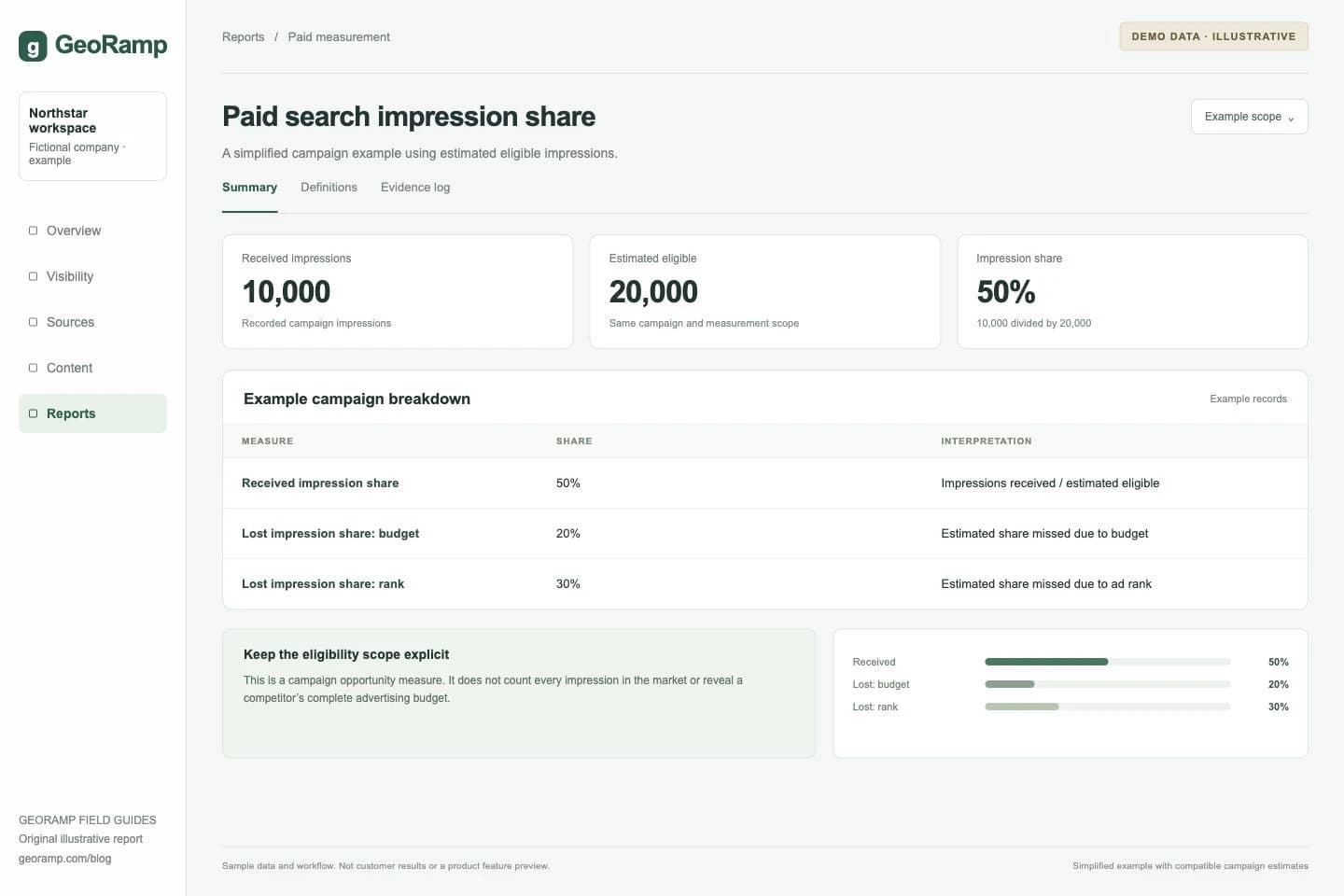
Illustrative report with fictional data and workflow examples. This is not a customer result or a preview of a specific product screen.
If targeting or eligibility changes, the rate can change even when received impressions remain stable. Review counts and campaign settings alongside the percentage.
Distinguish budget and rank constraints
Where the platform provides them, inspect lost impression share due to budget and due to rank for the same campaign scope. Those diagnostics point toward different investigations.
A budget constraint invites a review of whether additional eligible traffic would meet the business's economics. A rank constraint invites a review of bids, relevance, quality, and the landing-page experience. Neither observation automatically justifies higher spending.
Use compatible metrics and reporting dimensions. Do not combine lost-share percentages from unrelated campaign types or scopes and expect a meaningful total.
Read auction comparisons carefully
Auction insight reports describe overlap within the relevant auction context. They do not reveal a competitor's full budget, profitability, or total category reach.
Record the campaign, date range, geography, and targeting context when comparing advertisers. A change in your eligibility can alter which competitors appear in the report without implying the entire market changed.
Top-position measures answer a narrower placement question than total impression share. Check the current definition for the campaign type before interpreting one as a substitute for the other.
Put economics next to exposure
Review the conversion definition, quality of the resulting inquiries, and the cost of the incremental opportunity. An increase in impression share is useful only in the context of the campaign's purpose.
Check whether the page accurately describes the offer and whether the audience can complete the intended action. Spending more to send poorly matched visitors to an unclear page can amplify the wrong problem.
Keep budget decisions within a documented test plan with a spending limit and review criteria. The reporting metric should inform the decision, not make it automatically.
Do not confuse impression share with ESOV
Excess share of voice compares a defined SOV measure with a defined share of market. A campaign's eligible-auction impression share is not automatically compatible with the brand's revenue share for an entire category.
For a worked comparison, see share of market versus share of voice. If the denominators cannot be aligned, report the measures separately and explain the gap in scope.
Keep paid and AI visibility distinct
Paid exposure, organic presence, and generated-answer citations are different observations. An AI appearance does not imply a paid placement, and a paid impression-share improvement does not establish a citation gain.
Use marketing share of voice to place these channel rows in one review while retaining the definitions that make them interpretable.


