

A vendor demonstration uses friendly prompts and a clean example brand. Your trial should use the awkward questions buyers actually ask, including limitations, integrations, and alternatives.
The best AI visibility product for a team is the one that makes those observations reliable and useful in its operating workflow. A feature checklist is a starting point; a bounded pilot shows whether the product fits.
Choose the product category
Dedicated visibility platforms focus on generated-answer observations. Broader SEO suites combine conventional search research with AI visibility features. Content platforms increasingly add monitoring around their research and production workflows.
Application observability is another category: it monitors model-powered software you operate. Do not confuse that job with measuring public answers about your brand.
For named products and official sources, see the twelve-tool comparison. This guide focuses on how to run the selection process rather than declaring a universal winner.
Build a representative pilot brief
Choose one product, audience, language, and market. Include a small fixed group of category, integration, comparison, and pricing questions. Mark branded prompts separately from unbranded prompts.
State the collection surfaces and modes you need. Require a clear explanation of whether the observations come from consumer interfaces, APIs, or an existing provider dataset.
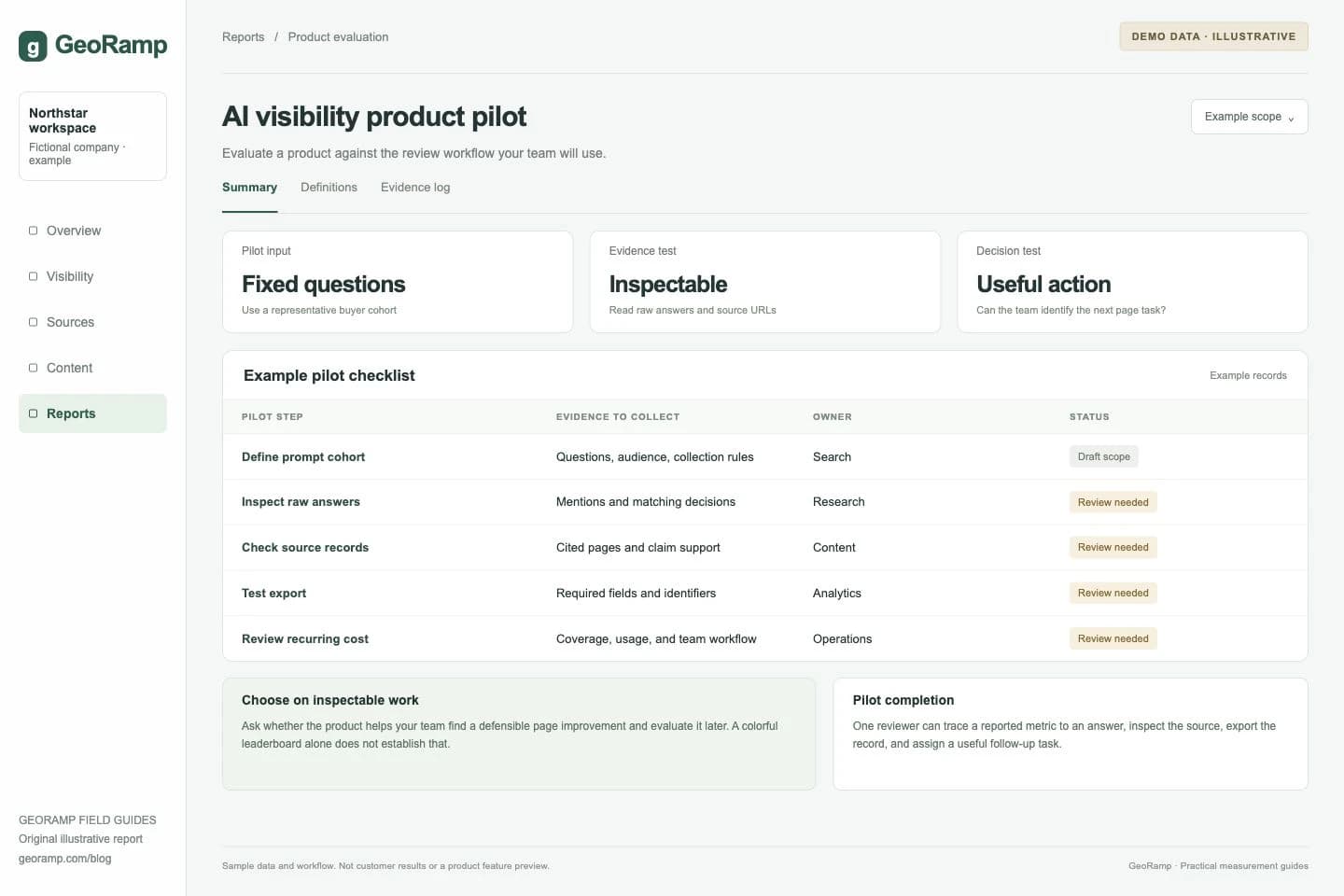
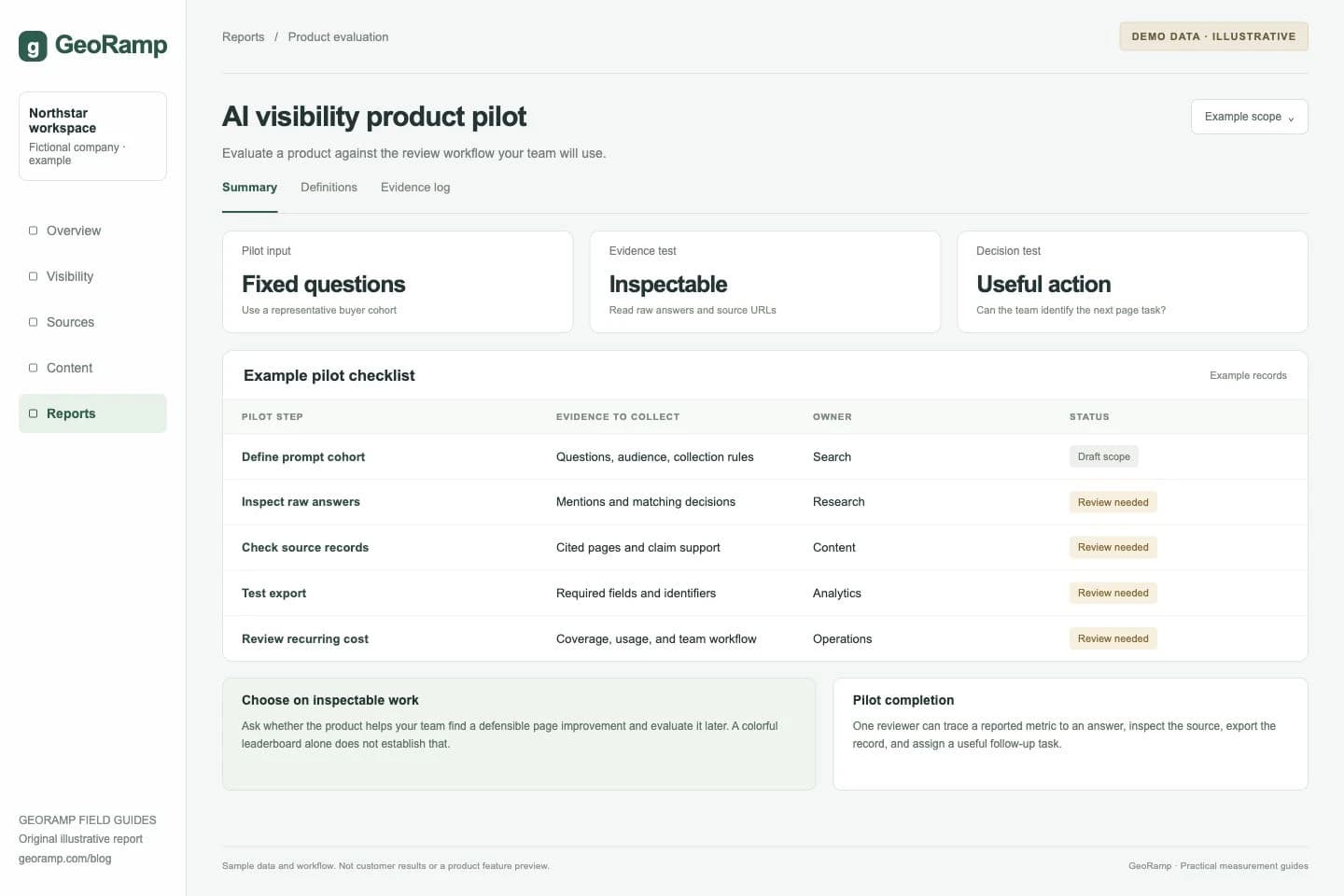
Illustrative report with fictional data and workflow examples. This is not a customer result or a preview of a specific product screen.
The example pilot board tracks setup, evidence inspection, export, and the decision. Its statuses describe a proposed evaluation, not measured vendor rankings.
Inspect raw evidence before the score
Select a few prompts and follow their responses into the dashboard. Check brand matching, source URLs, collection times, repeated runs, and failed-response handling.
Ask the vendor to explain its denominator. A share of all citation events and a rate of responses mentioning the brand are different metrics. If a score combines them, ask for the weighting and the original counts.
Test a difficult case: a brand alias, a third-party citation about your product, or a response that mentions several alternatives. The system's handling of ambiguity matters more than a perfectly clean demo row.
Test the human workflow
Have a content owner inspect a gap and create a specific page task from the evidence. Have a reporting owner reproduce a summary from the export. Have the team compare two periods without silently changing the prompt set.
Record where manual work remains. Manual review is not necessarily a defect, especially for nuanced interpretation. The question is whether the workload is understood and manageable.
Check ownership and portability. Your team should know what it can retain if it cancels the subscription and whether the original observations remain accessible for a later audit.
Price the intended sample
Estimate the number of prompts, platforms, repeat runs, and reporting periods. Include seats, workspaces, retention, and required exports. Compare proposals at that workload rather than at their lowest advertised entry price.
Consider the operating cost of reviewing the output as well as the subscription. More observations are not automatically valuable if nobody can turn them into an informed decision.
Make a narrow adoption decision
Choose the product that meets the essential requirements and supports a useful next cycle. Document unresolved gaps and the conditions for expansion. Avoid selecting software on a promise that it can force another company's assistant to recommend your brand.
If your team needs execution capacity more than another report, evaluate an AI visibility service provider. If procurement requires a formal checklist, use the metrics platform scorecard.
Choose a tool for your actual workflow
For current prices, documented engine scope, free options, and practical limitations, read our researched comparisons and audience buying guides. We make GeoRamp and explain when we would choose a competitor. Research checked October 8, 2026.


