


A search team should not abandon useful pages because an assistant can summarize them. The practical change is in what you observe: a page's search position, its role as a source in an answer, and the visits or conversations that follow.
Traditional SEO and AI search work share much of the same source material. The main operational differences are the surfaces being measured and the evidence needed to interpret their output.
Compare the jobs, not the labels
| Work | Conventional search view | AI answer view |
|---|---|---|
| Discovery | Can a search engine find the page? | Can the relevant retrieval system access useful source material? |
| Content | Does the page satisfy the search task? | Can its facts support a useful, accurate answer? |
| Observation | Rankings, impressions, clicks | Mentions, linked citations, source pages, impressions where available |
| Outcome | Useful visits and conversions | Useful visits, accurate descriptions, qualified discovery |
These columns overlap. An assistant can cite a page that also ranks well, and a visitor can move between search, assistants, reviews, and your website during one evaluation.
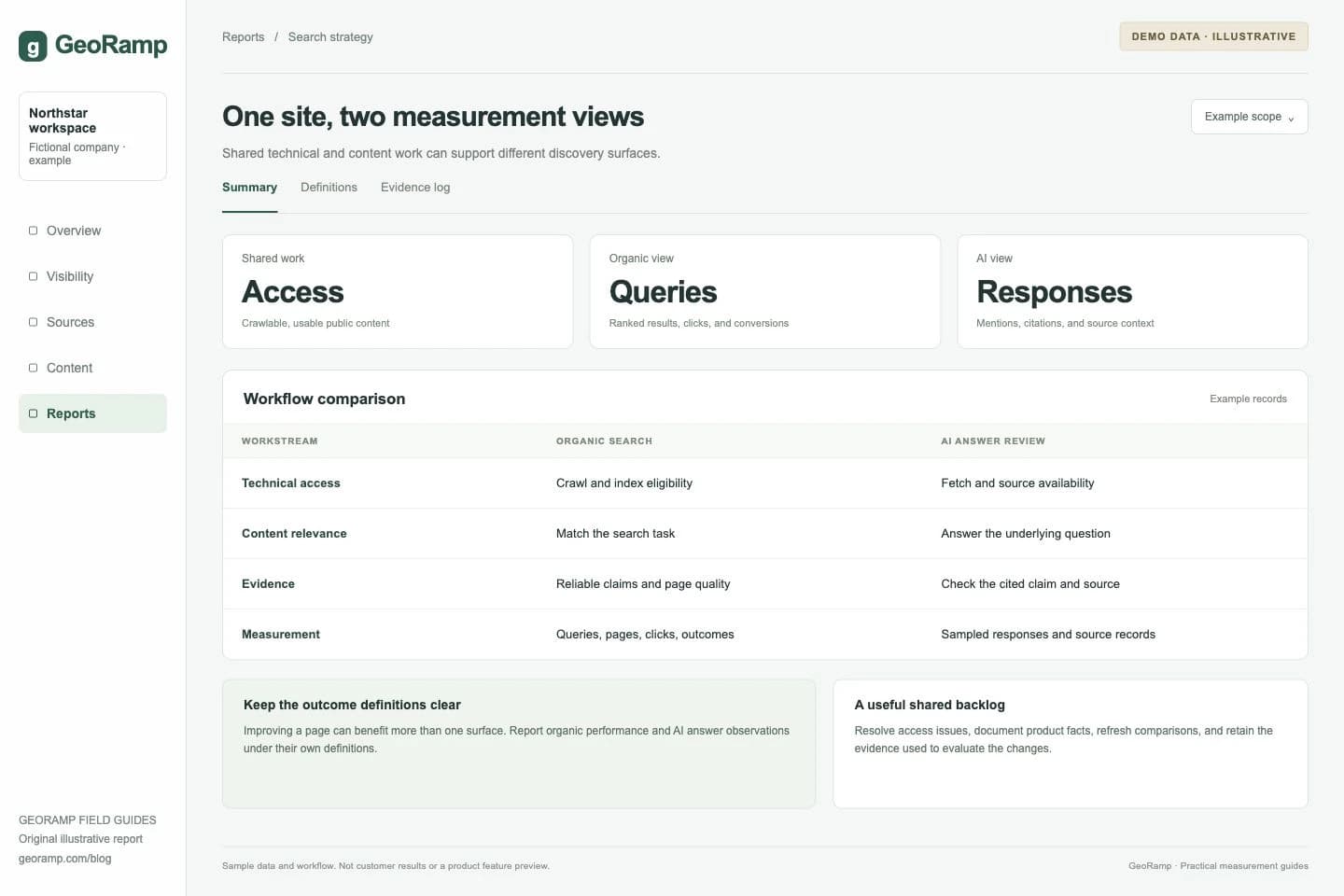
Illustrative report with fictional data and workflow examples. This is not a customer result or a preview of a specific product screen.
Keep the technical foundations
Maintain working public URLs, sensible internal links, correct canonicals, and reliable page delivery. Do not treat an AI-specific checklist as a substitute for basic site maintenance.
Google's AI search optimization guidance connects its generated-answer features to established Search foundations. Check provider documentation when deciding which crawler controls affect a different assistant.
Avoid assuming all systems render pages identically. Inspect the initial response and rendered text when critical information appears only after interaction. The page inspector guide provides a concrete diagnostic workflow.
Add evidence that helps a buyer decide
A vague product description is weak source material regardless of the interface that finds it. Explain capabilities, limits, prerequisites, and supported use cases. Make comparisons fair and specific enough for a visitor to act on.
Use a short answer near the relevant heading when it improves readability, then provide the context that keeps the answer accurate. Do not impose a universal paragraph length or keyword density on every topic.
If a page makes an empirical claim, link the original evidence and explain its scope. If it uses a worked example, label the figures as illustrative. Neither a citation nor a schema block repairs a fabricated claim.
Add a second observation layer
Keep organic reports and add a stable sample of buyer prompts. Store the assistant, mode, language, date, raw answer, and source URLs. Count brand mentions separately from citations to your own domain.
In the example reporting design, the search and assistant datasets remain separate. A 30% answer appearance rate cannot be compared directly with a 30% search click-through rate because they count different events.
Use Google's generative AI report where available, alongside its broader search performance data. For external assistants, use documented prompt observations and identifiable referrals. The Search Console guide explains those boundaries.
Run one editorial workflow
Use a shared backlog with the buyer question, current page, evidence gap, proposed change, and owner. That keeps teams from creating duplicate “AI” versions of material they already maintain.
After publication, review the page's search performance and the corresponding prompt sample. A gain in one surface does not make the other irrelevant. Investigate the source of the movement and whether it helps the business.
For implementation planning, use the AI SEO strategy guide. For a measurable reporting format, start with the keyword rankings and visibility template.


