


A webinar produces 200 registrations and no useful sales conversations. Another program brings fewer visitors but repeatedly helps buyers resolve a deployment objection. Counting activity alone will make the first program look better.
B2B demand generation works best when the team agrees on the buying problem it wants to influence and the evidence that would show progress. AI search can be one discovery surface in that program, alongside search, communities, partners, email, and events.
Start with a buying situation
Choose a specific audience and trigger: a team replacing a fragile workflow, adding a compliance requirement, or evaluating a new integration. Document the current workaround, the cost of leaving it unchanged, and the objections that stall action.
Build content and distribution around that situation. A useful implementation checklist can serve a buyer better than another broad category article. A workshop can be valuable when participants leave with a decision they could not make beforehand.
Match channels to the next useful action
| Program | Useful role | Evidence to review |
|---|---|---|
| Problem-focused content | Explain the problem and options | Qualified visits, sales usage, next-page behavior |
| Partner workshop | Demonstrate a shared workflow | Relevant attendance, questions, follow-up requests |
| Account-focused outreach | Start a relevant conversation | Replies and qualified meetings |
| Email education | Help an interested buyer continue | Engagement with the next decision |
| Community participation | Answer genuine questions | Relevant discussion and source discovery |
| AI search monitoring | Observe generated-answer coverage | Accurate mentions, citations, identifiable referrals |
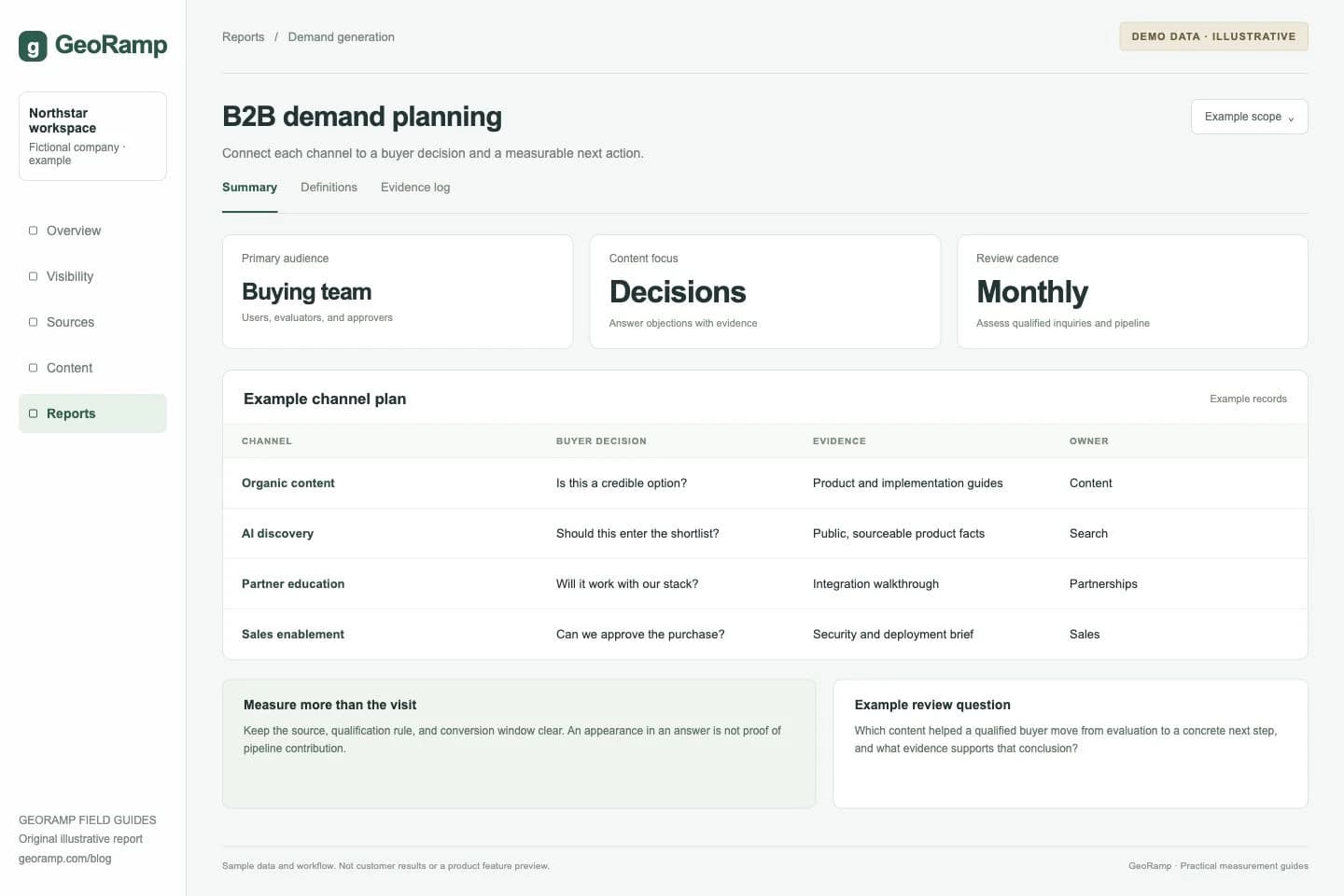
Illustrative report with fictional data and workflow examples. This is not a customer result or a preview of a specific product screen.
The example planning board assigns an owner and a decision to each program. Its numbers and statuses are illustrative; the channels do not carry universal performance scores.
Build reusable proof
Create source material that can support several formats: a documented workflow, a tested integration guide, a calculator, or a carefully attributed research note. Adapt the explanation for an email, a workshop, or a sales conversation without changing the underlying facts.
If you use a customer story, obtain the appropriate permission and preserve the actual measurement. If no verified case study exists, publish an explicitly hypothetical worked example rather than inventing a customer result.
Keep proof close to the objection it addresses. A buyer asking about migration effort needs the migration sequence, prerequisites, and limitations, not an unrelated growth percentage.
Give distribution an owner
Publication is one task. Reaching the intended audience is another. Define who will share the resource through existing, appropriate channels and what context will make the share useful.
For partner programs, agree on the audience, landing page, follow-up, and measurement before the event. For sales enablement, make the material searchable and show the team which questions it answers. For email, connect each message to a meaningful next step rather than an arbitrary sending frequency.
Add AI search as a bounded experiment
Choose buyer questions that overlap with the content program. Observe a fixed prompt sample, inspect the cited pages, and check whether the product is described accurately. Use the results to identify missing facts and useful comparison material.
Do not count a sampled citation as a lead. Compare visibility observations with identifiable referrals and buyer-reported discovery. The AI search market guide explains how to choose platforms without inventing a market-share model.
Review decisions, not just dashboards
At the end of a cycle, ask what the program taught you about the buying situation. Which objection appeared repeatedly? Which resource helped sales? Which distribution effort reached the right audience? What should change next?
Keep cost and team capacity in the review. A promising channel that nobody can operate reliably may deserve a smaller scope. Use competitive analysis for context and the content gap template to turn the next learning into a concrete brief.


