

“Our share of visibility is 25%” can mean a quarter of estimated organic clicks, a quarter of tracked mentions, or an appearance in a quarter of sampled AI answers. Those are different claims.
Use share of visibility as a label only after defining the surface, event, comparison set, and weighting method. A clear definition makes the number useful; a broad label does not.
Choose the event you can measure
For organic search, a provider may estimate potential clicks by applying a click-through model to positions and keyword volumes. That produces modeled visibility within the selected keyword set.
For a competitive mention dataset, share can mean one brand's qualifying events divided by all qualifying events across the chosen brands. For AI answers, an appearance rate usually divides responses containing the brand by successful sampled responses.
The last measure can overlap across brands. An answer that names three vendors contributes an appearance to each. Their rates need not sum to 100%, so do not put them into a market-share pie chart.
Work through an organic example
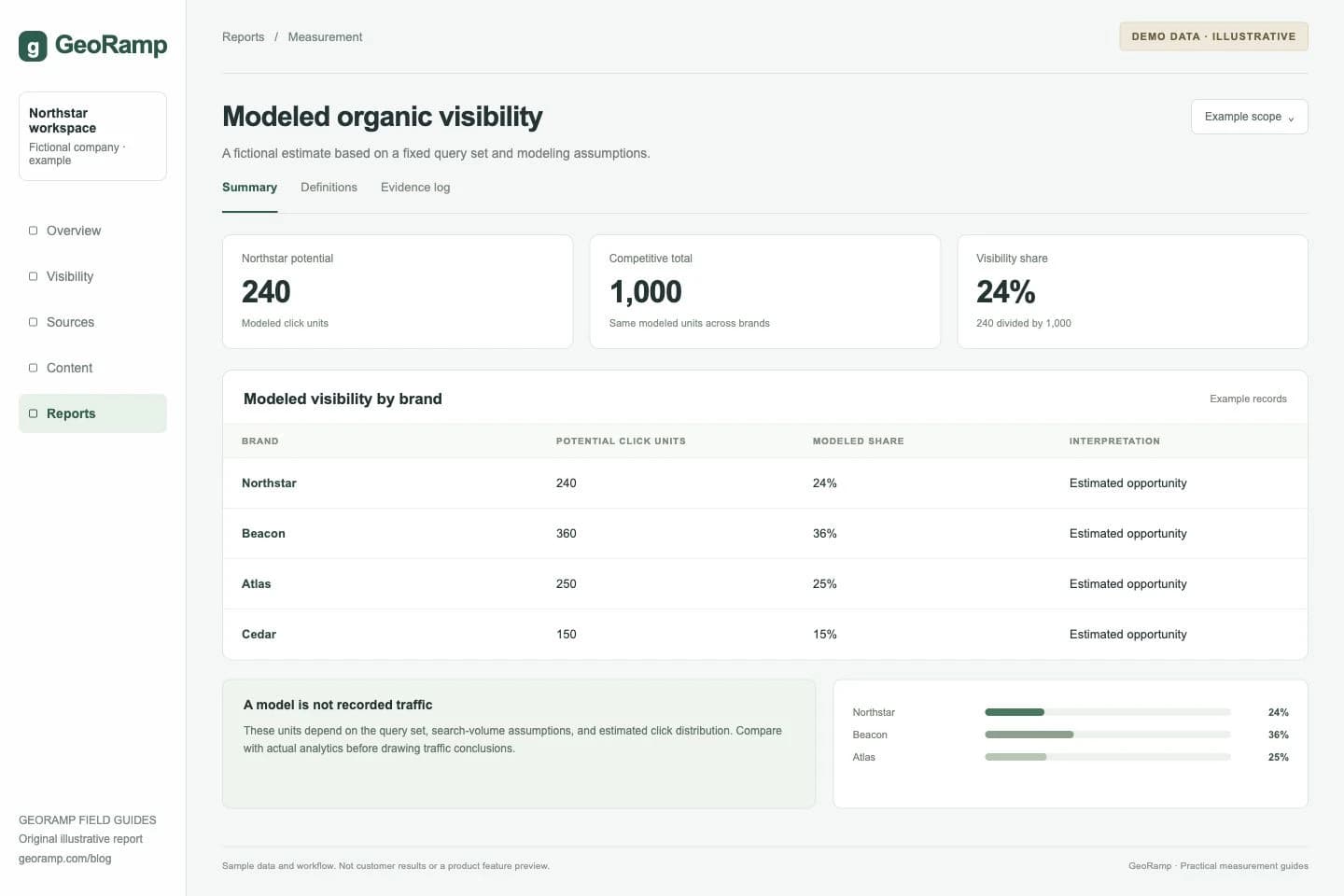
Suppose an illustrative keyword model assigns Northstar 240 potential clicks and the defined competitive set 1,000 in total. Northstar has 24% of modeled visibility in that set.
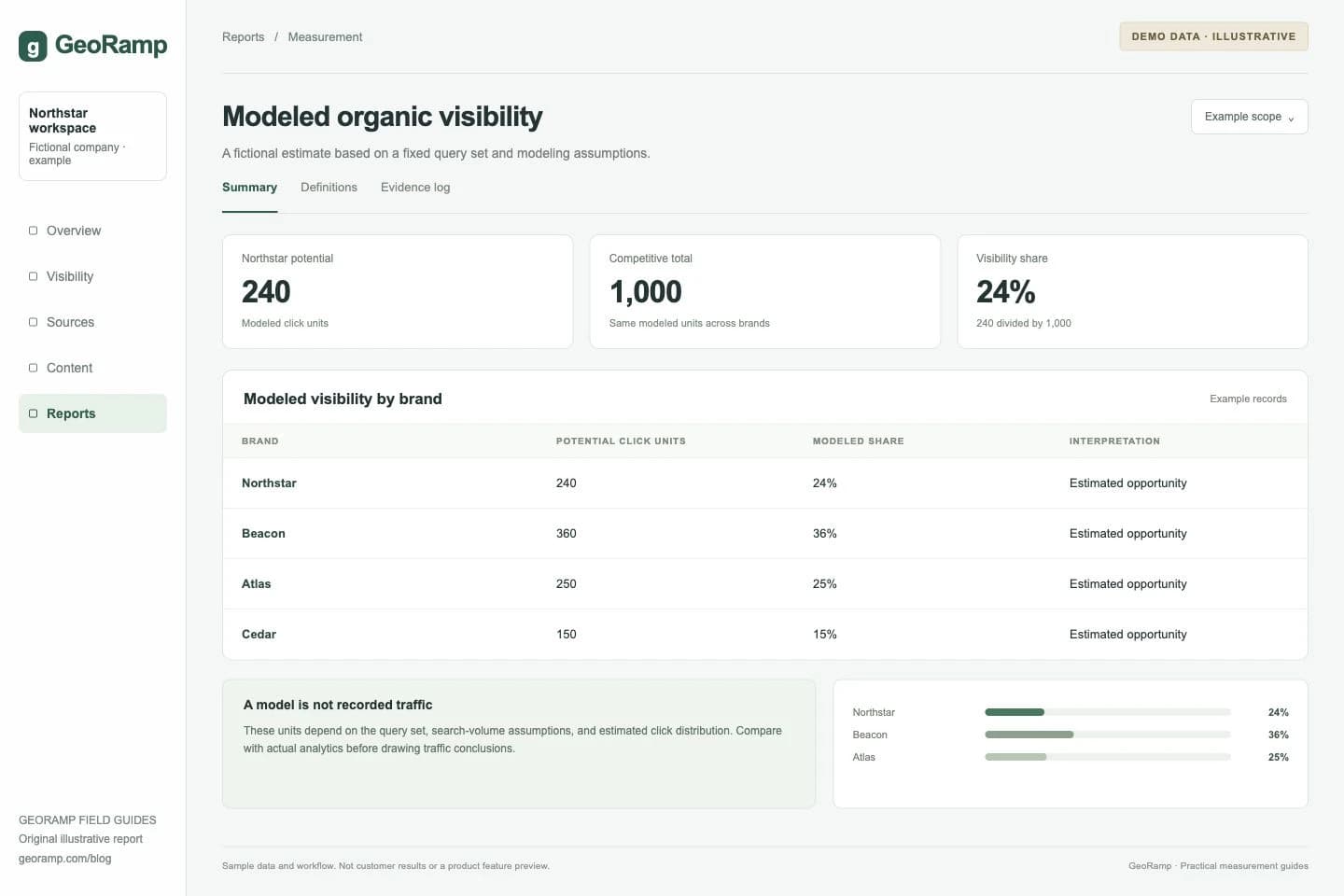
Illustrative report with fictional data and workflow examples. This is not a customer result or a preview of a specific product screen.
That is not 24% of all searches, all website visits, or all buyers. The estimate depends on included queries, search-volume inputs, observed positions, and the click model. Retain those assumptions when comparing periods.
Separate share of visibility from share of voice
The terms overlap in marketing practice. Share of voice often refers to advertising or mentions; visibility often refers to exposure or a modeled search opportunity. Neither has one universal cross-channel formula.
Choose language that tells readers what happened. “Share of tracked social mentions” and “AI answer appearance rate” are more useful than two columns both labeled “SOV.”
The share-of-voice calculation guide provides denominator examples. The measurement guide covers collection quality.
Keep an index transparent
If management needs one planning index, choose stable weights and disclose them. Keep the component metrics visible and avoid presenting the result as a literal share of a combined audience.
An index can improve because its weights changed, because a new source was added, or because a component moved. A report should distinguish those mechanisms. Otherwise the team may celebrate a mathematical redefinition as improved performance.
Do not compare proprietary scores from different vendors as if they used the same scale. Ask for their formulas and observed counts before interpreting the difference.
Connect visibility to the next task
Segment by buyer problem and inspect the underlying pages. A low score on an irrelevant topic may deserve no action. A missing explanation for a recurring product objection may deserve immediate work even when the estimated audience is small.
Keep observed exposure separate from traffic and qualified outcomes. Visibility can be useful without an immediate click, but that does not justify inventing attribution for downstream revenue.
Use the marketing SOV guide for a cross-channel review and the one-page report to give each material gap an owner and a next decision.


